The room service phone has been the same bottleneck for decades: the guest calls, no one picks up, they call again, struggle with language barriers, and eventually give up. The order never arrives, and neither does the revenue. Worst of all, the kitchen team has no idea how many orders to expect or when.
The real problem behind traditional room service
Room service remains one of the channels with the greatest ancillary revenue potential in a hotel, and also one of the most consistently underperforming. Not due to lack of demand, but due to friction.
The classic flow — printed menu, phone call, manual order-taking — creates problems at multiple points. Guests don’t always find the menu. When they do, it may be out of date. The call depends on someone answering at exactly the right moment, in the right language, with the availability to handle modifications, allergies, or special preferences.
From the operational side, orders arrive irregularly, without advance notice, and are handled alongside other kitchen tasks. This puts pressure on delivery times, which are directly proportional to guest satisfaction and the final NPS.
The result is that many hotels maintain room service as a prestige offering rather than a genuine revenue channel. Conversion is low, the average ticket falls short of its potential, and the operational cost per order is disproportionate to the margin it generates.
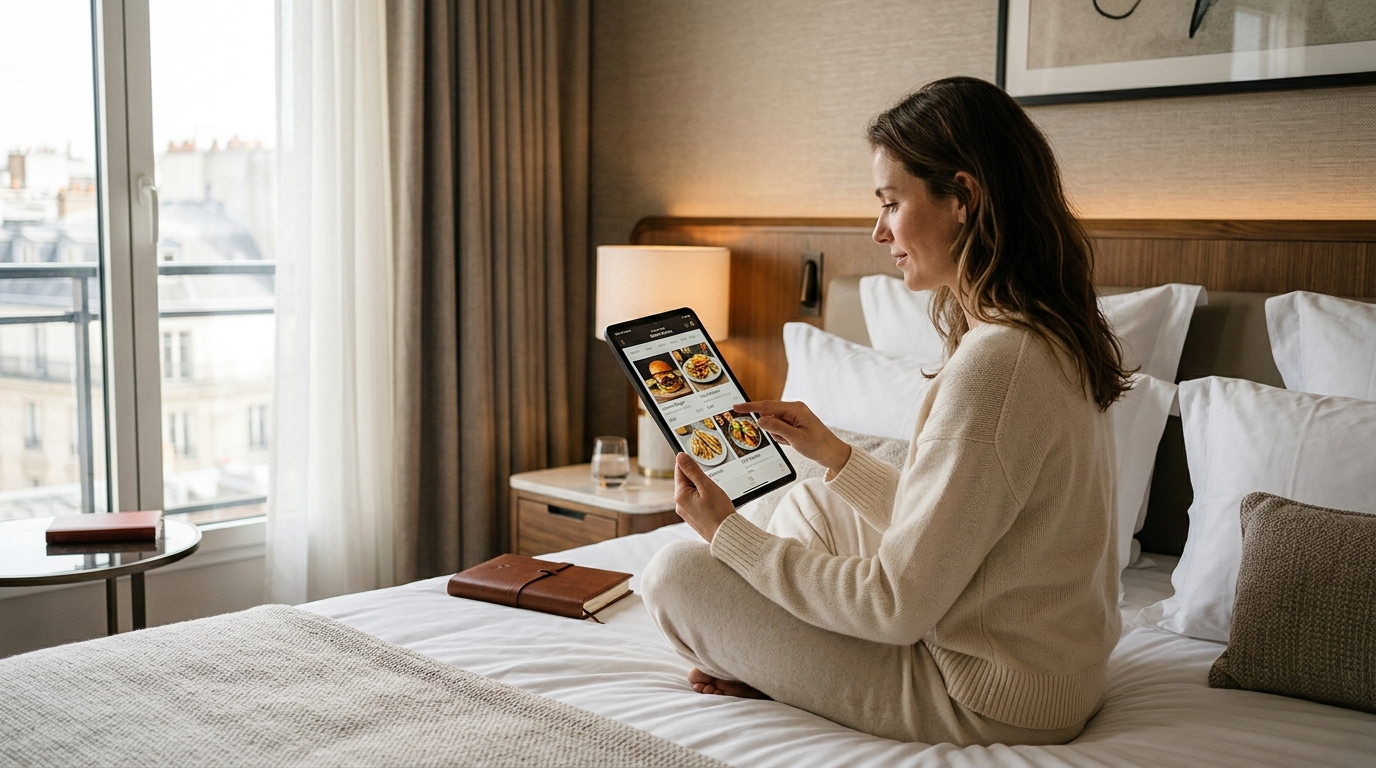
The problem is not the service itself. It is the channel. A guest who is hungry at 11 PM does not want to wait for someone to pick up the phone. They want to order in thirty seconds from the sofa, just as they do with any delivery app in their daily life.
The logic of digital room service in a hotel
The shift towards digital hotel room service is not about replacing staff, but about eliminating the friction points that prevent orders from happening in the first place. The guest already has their device in hand. The only thing that changes is what they do with it.
A QR code in the room, on the bedside table, or on the balcony table opens the digital menu directly — customisable by language, with photos, descriptions, allergens, and real-time availability. The guest selects, customises, confirms, and pays or charges the order to the room. No phone calls, no waiting, no misunderstandings.
From the kitchen, the order comes through directly in the system with room number, time, and specifications. This allows production to be organised, delivery times to be estimated, and the guest to be informed of when their order will arrive — reducing follow-up calls to virtually zero.
This model also opens up upselling opportunities that phone calls never had. The moment a guest adds a burger to their cart, the system can suggest a local craft beer or a dessert. No pressure, no need for a member of staff to remember to recommend it. Automatic upselling within the digital menu can consistently and sustainably increase the average ticket.
Availability also changes. A small overnight team can handle digital orders with far less effort than the same volume of phone calls, because orders arrive structured and require no interaction to be taken.
How to implement it and make it work in practice
The success of digital hotel room service depends on a few details that make the difference between a system guests actually use and one they ignore.
The menu must always be up to date. If a product is sold out and a guest orders it, the experience breaks down. Systems that allow products to be activated and deactivated in real time from the kitchen or front desk eliminate this issue. It is equally important that the menu reflects the actual service hours so guests cannot complete orders outside those windows.
Access must be immediate. A QR code that takes too long to load, requires registration, or fails to work on the guest’s phone destroys the channel before it even begins. A download-free Guest WebApp — like the one Hoteligy integrates in its Digital Room Service module — solves this: guests access it directly from their phone’s browser, with no installation required and no account creation unless the hotel requires it.
PMS integration is what closes the operational loop. Automatically charging the order to the room without front desk involvement is what turns digital room service into an efficient channel, rather than just an attractive-looking menu.
The entry point matters. A QR code in the room is the minimum. But hotels with the highest conversion rates complement it with mentions on the in-room TV channel, on Digital Signage in the corridor, in the welcome message on the chat, or even in the pre-check-in. The more touchpoints, the greater the likelihood that guests will remember the service exists when they need it.
The data this channel generates is valuable. Which products are ordered most, at what times, from which room types, which upsells perform best. This information allows you to refine your offering, adjust prices based on demand, and make decisions about overnight kitchen operations based on real insight rather than guesswork.
A common mistake is to launch the channel and then fail to monitor it. The digital menu is not a PDF behind a QR code. It is a live channel that requires active management: content updates, upselling tests, conversion analysis. Hotels that treat it as an active channel see sustained results; those that set it up and forget it do not.
Finally, the team must know the channel exists and how it works. If front desk staff cannot explain to a guest how to use the QR code in thirty seconds, or if the kitchen does not know where to view incoming orders, the system fails on the human side, not the technological one.
Conclusion
Digital hotel room service is not a cosmetic improvement. It is a shift in the logic of the channel that reduces friction for the guest, eases the operational load on the team, and generates a more predictable flow of orders with a higher average ticket. Hotels that implement it correctly see a service that once existed out of inertia become a genuine TRevPAR channel. The technology is already available; the question is how much revenue continues to be lost while the phone rings with no one picking it up.
Want to see how Digital Room Service works in your hotel? Request a demo at hoteligy.com/demo and we will show you how it fits your real operation.