In a 400-room all-inclusive hotel, the buffet generates between 15% and 20% of the complaints registered at reception. Most are not about the food: they are due to incorrect, outdated, or missing information about dishes and allergens.
Paper labels in the buffet carry a structural problem: they rely on someone printing them, placing them correctly, and changing them every time a dish rotates. In a service with 60-80 references per shift, that chain fails several times a day. And every failure translates into a complaint, a query to the waiter, or—in the worst-case scenario—an allergic reaction.
The Real Cost of Paper Labels
The problem is not just operational. It involves legal, reputational, and financial risks.
Legal risk. EU Regulation 1169/2011 makes it mandatory to provide information on the 14 main allergens in all food served. In a buffet with constant rotation, guaranteeing this traceability with printed labels is practically impossible. It only takes a waiter changing a tray without updating the sign for the hotel to be in breach of compliance.
Impact on NPS. F&B-related complaints at the buffet systematically appear among the top three causes of negative reviews in holiday resorts. A celiac guest who cannot find clear information about gluten loses trust in the entire hotel operation, not just breakfast.
Hidden operational cost. Replacing, printing, laminating, and placing labels for every service consumes between 45 and 90 minutes daily of a kitchen team member’s time. In hotels with three buffet shifts, that is more than 4 hours/day not dedicated to production.
Friction with international guests. A buffet with labels only in Spanish or English leaves out a significant percentage of German, French, Scandinavian, or Polish clientele. And the front-of-house team cannot always explain ingredients accurately in five languages.
What Changes with Digital Labels
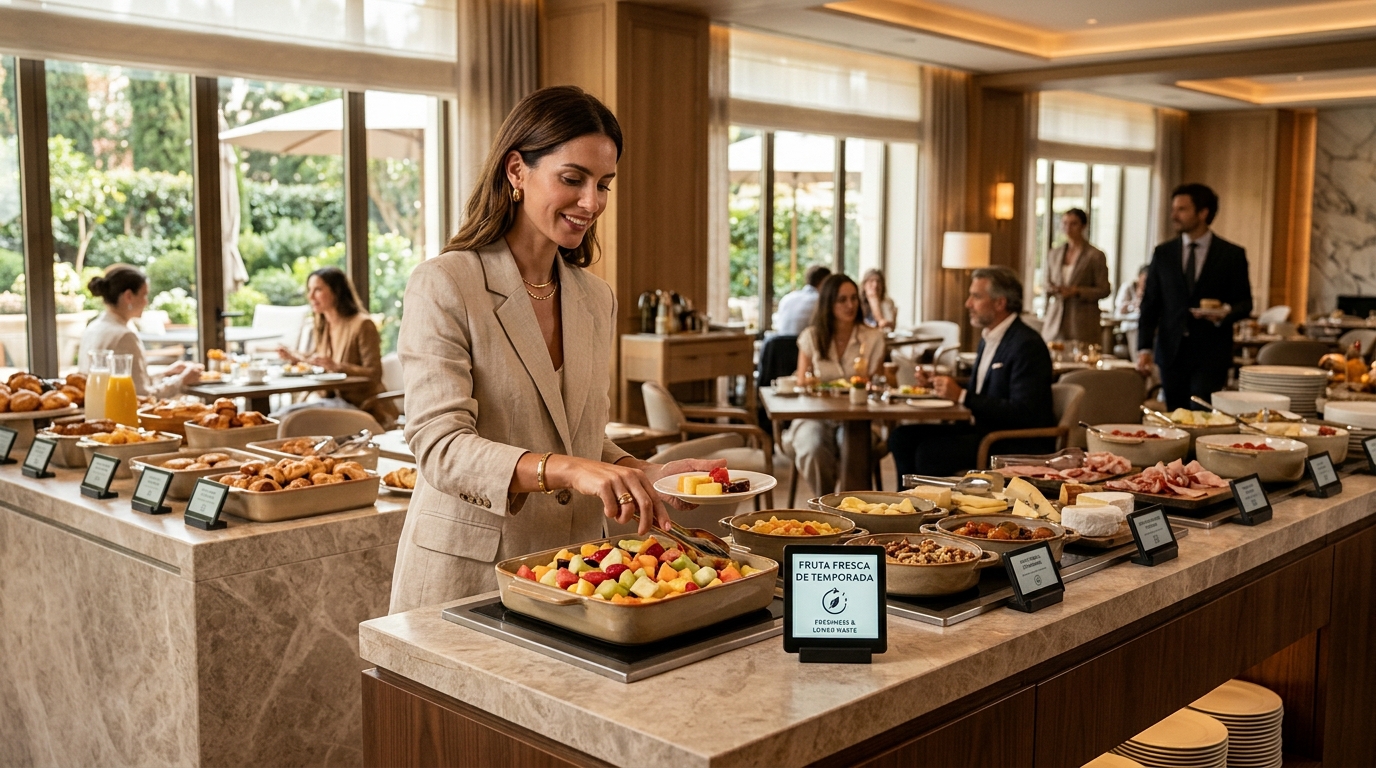
Digital buffet labels resolve these four fronts with a single technological layer: e-ink or LCD screens synchronized with the hotel’s CMS, displaying the dish, description, allergens, and automatic translation into several languages.
Each label is a content unit managed from the same panel where digital menus, Digital Signage, or the Guest WebApp are edited. When the chef changes the Sunday brunch menu, they update it once, and all buffet labels reflect the change in seconds.
Real-Time Allergen Traceability
Each dish is associated with its technical sheet containing the 14 mandatory allergens. If a waiter replaces the lasagna with a gluten-free alternative, the change is instantly reflected on the label. There is no room for a celiac guest to see outdated information.
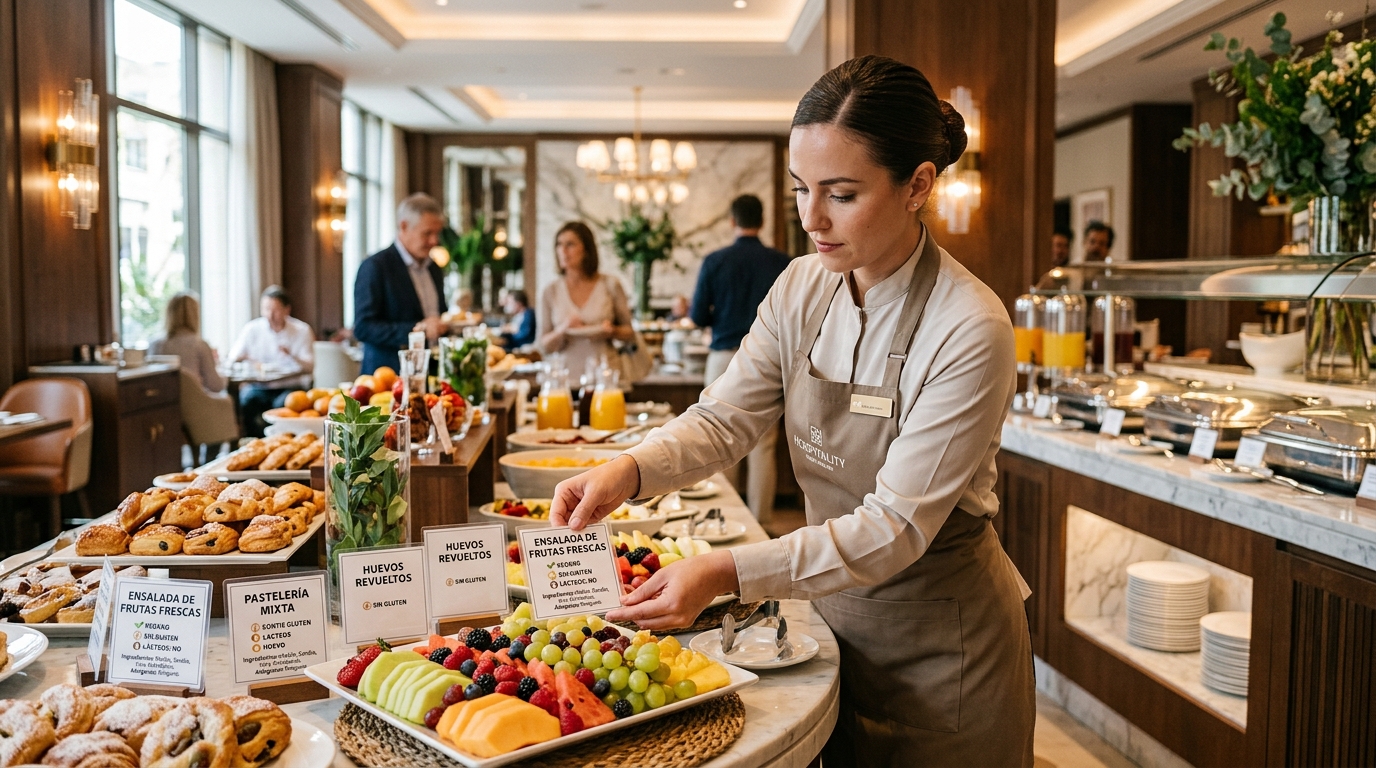
In addition, the system allows for standardized iconography: vegan, vegetarian, lactose-free, halal, kosher, spicy. Visual communication replaces text and eliminates the language barrier.
Frictionless Multi-language
The guest presses (or the team configures by time slot) the buffet language: Spanish, English, German, French, Italian, Dutch, Portuguese. The same label displays the translated information without the need to print different versions.
This is particularly critical in resorts with a mix of nationalities. A German customer who sees “Bacalao a la vizcaína” without further context will probably avoid it; the same guest, seeing the description and allergens in their language, consumes it and values the gastronomic experience positively.
Synchronization with the Rest of the Digital Ecosystem
Here is the multiplier. When labels are integrated with the Guest WebApp and the Room Service Digital (or digital menu), guests can check from their mobile phones, before going down to the buffet, what is being served today and filter by their dietary restrictions.
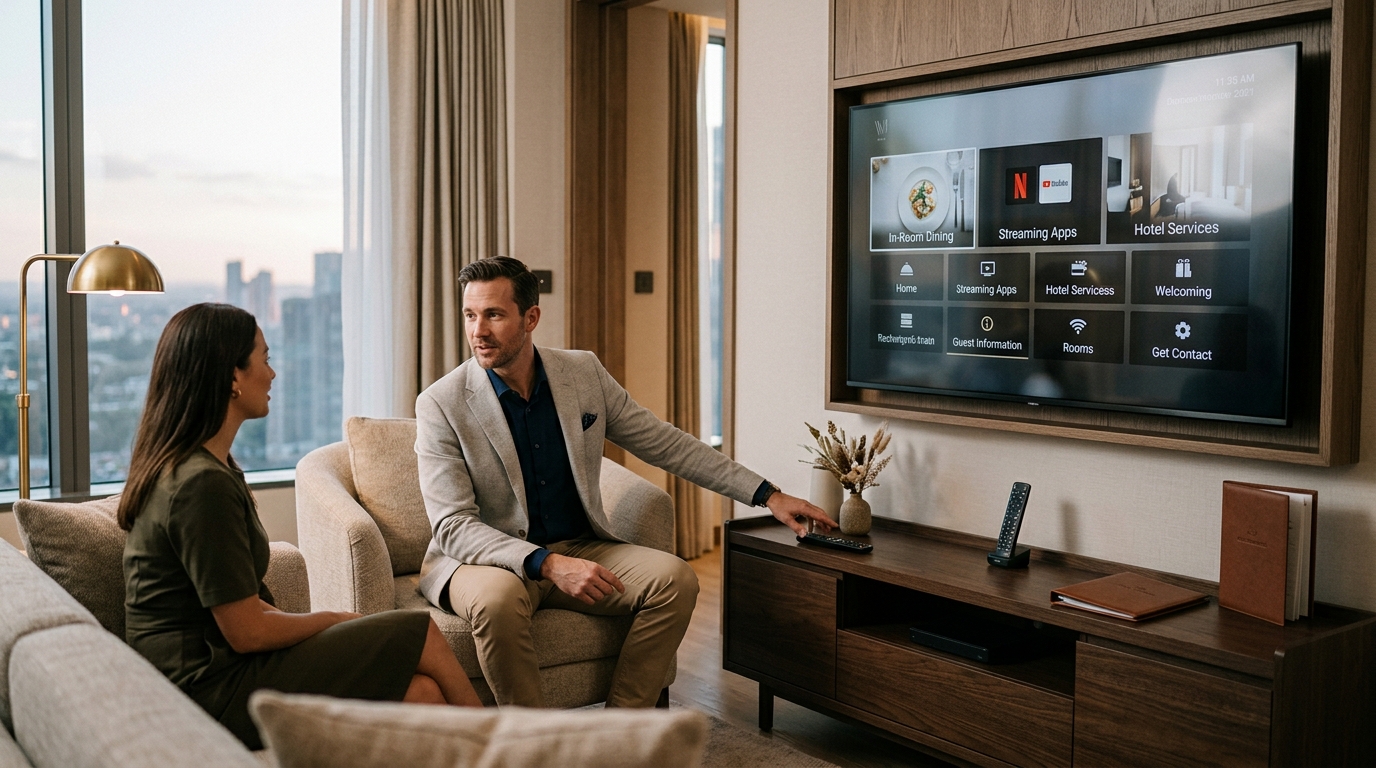
In hotels using the Hoteligy 360 CMS, information flows between physical labels, WebApp, restaurant signage, and the in-room TV channel. A single data source feeds all touchpoints.
How to Implement It Without Operational Friction
Technology adoption in F&B usually fails for two reasons: excessive complexity for the kitchen team or lack of integration with the existing workflow.
1. Start with Breakfast
Breakfast is the service with the lowest rotation (dishes are repeated almost every day) and the one that generates the most allergen complaints. It is the best starting point for implementing digital labels.
Configure the 30-40 usual references once (scrambled eggs, bacon, cheeses, cold cuts, pastries, fruit, cereals, drinks) with their complete sheet. From there, variations are managed as exceptions.
2. Define a Workflow with the Kitchen Team
The sous chef or the chef de partie should be the one updating the content, not the systems team. The platform must allow editing from a tablet or mobile phone, with role-based validation, so that any change in the kitchen is reflected in the buffet without going through IT.
In hotels like those of our clients, this decentralized management reduces label update time from 45 minutes per service to less than 5.
3. Integrate with the Survey Module
Cross-reference digital labels with satisfaction surveys to measure the real impact. Ask specifically about buffet information: Did you find the information you needed? In your language? About allergens?
This feedback loop allows you to iterate on label content and detect which dishes generate more queries or doubts.
4. Train the Front-of-House Team as Backup
Labels do not replace the team; they complement them. Waiters go from answering basic questions about ingredients to resolving high-value queries: recommendations, wines, alternatives. It is a role shift that improves the perceived experience.
Measurable Results Within 90 Days
Hotels implementing digital buffet labels report consistent patterns in the first quarter:
Reduction in F&B complaints. Fewer incidents registered at reception and in guest requests and incidents related to buffet information, allergens, or unidentified dishes.
NPS improvement in the F&B segment. Specific buffet ratings in post-stay surveys rise steadily when information is accurate, multi-language, and visually clear.
Operational savings. Time spent managing paper signage is freed up for production tasks. In medium-sized hotels, this is equivalent to recovering the equivalent of half a working day in the kitchen team.
Reduction of legal risk. Digital allergen traceability leaves an auditable record of what information was displayed at any given time. In the event of a claim, the hotel can prove that communication was correct.
Upselling in premium F&B. By freeing the front-of-house team from answering basic queries, the time spent recommending wines, fresh seafood, or à la carte dishes with a supplement increases. Buffet ancillary revenue grows measurably.
Conclusion
Digital buffet labels are not an innovation project: they are a correction of an operational pain point with a direct impact on NPS, labor costs, and legal risk. In high-volume hotels, the ROI materializes in the first quarter of operation.
The key is not to isolate the module. Integrated with the WebApp, the digital menu, and the survey system, labels become another node in the hotel’s digital ecosystem, not just another technological island to maintain.
If your buffet operation still relies on laminated paper and manual updates, there is clear room for improvement in KPIs that matter: complaints, satisfaction, cost, and regulatory compliance.
Want to see how digital buffet labels work in your specific operation? Request a personalized demo with our team: hoteligy.com/demo