Complaints at the buffet are rarely about the food itself: they are about incorrect information, poorly labeled allergens, dishes without translated names, or outdated signage. An operational failure that directly impacts NPS and, in the worst-case scenario, guest safety.
In holiday hotels with buffets featuring 60-120 items per service, keeping paper signage updated is a manual, slow, and error-prone process. A dish change at 8:15 AM is not reflected until someone prints, laminates, and places the card. Meanwhile, the guest reads incorrect information.
Digital buffet labels solve this problem at its root: centralized information, updated in seconds, and synchronized with the reality of the service. Let’s look at how to apply it and what operational impact to expect.
The real cost of static signage
Before talking about the solution, it is worth quantifying the problem. In a 400-room all-inclusive hotel, the F&B team manages approximately:
- 80-120 rotating dishes at breakfast, lunch, and dinner
- 4-8 languages depending on the market mix
- 14 mandatory allergens under European regulations (Reg. 1169/2011)
- 3-5 unplanned menu changes per service (shortages, substitutions)
Maintaining this on paper involves between 90 and 150 minutes of daily work for the chef de partie or the buffet manager, in addition to the recurring cost of printing, laminating, and replacing cards. And most importantly: any discrepancy between the actual dish and the sign translates into a potential complaint.
Internal data we see in hotels that have implemented digital labels show an average reduction of 60-75% in complaints related to buffet information, especially those linked to allergens and translations.
Three use cases that justify the investment
1. Allergen management with zero margin for error
This is the highest-impact use case. Regulations require informing guests about the 14 main allergens, but printed formats often rely on small, hard-to-read icons or numerical codes that guests cannot easily interpret.
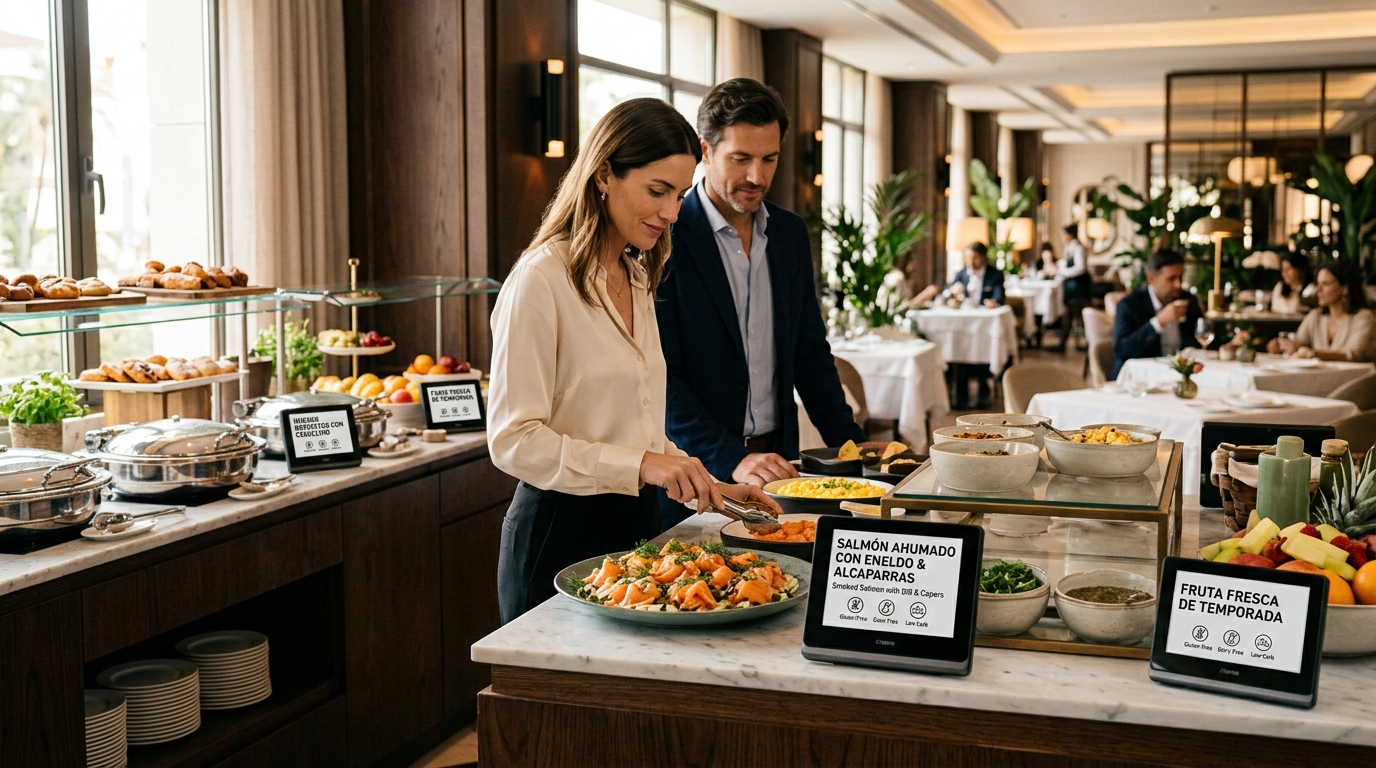
With digital labels, each dish displays allergens with clear iconography, automatically translated into the guest’s language and linked to the supplier’s technical sheet. If the kitchen changes an ingredient on the fly (for example, substituting butter with margarine), the update is reflected in seconds.
Expected operational outcome: allergen incidents close to zero and documented traceability in the event of a complaint.
2. Real-time dish rotation
A live buffet changes constantly. The pasta dish at 1:00 PM is not the same as the one at 2:30 PM. With paper signage, either the sign becomes obsolete or someone has to replace it manually. With digital signage, the change is scheduled by time slots or executed from a central panel.
This also allows for smart rotations: if a tray runs out early, the label updates to show the replacement dish without needing to print anything. The guest always reads correct information.
3. Reducing team time spent on non-productive tasks
The time the buffet manager spends on signage is time not spent supervising service, training the team, or managing mise en place. Centralizing management from the unified CMS frees up between 8 and 12 hours per week per restaurant, depending on the volume of the operation.
That time is reinvested in what actually moves the needle: product quality, guest service, and training.
How to implement it without operational friction
Implementing digital labels is not just a hardware change. It is a process change. These are the critical steps to make it work:
Initial audit of menus and technical sheets. Before installing anything, it is advisable to have all recipes with their composition and allergens loaded into the system. If the source data is wrong, the labels will display wrong data. This step usually requires 2-3 weeks of preparation work with the head chef.
Definition of visual templates per point of sale. The breakfast buffet does not need the same level of detail as a themed dinner. Templates are configured once and reused, including hotel branding, active languages, and level of information (name, ingredients, allergens, nutritional values, product origin).
Integration with existing systems. Digital labels deliver more value if they are connected to the hotel’s digital menu and the information displayed on the Guest WebApp. A change in the kitchen is simultaneously reflected on the buffet label and on the query the guest makes from their mobile phone.
F&B team training. It is not complex, but it requires a couple of short sessions. Buffet managers learn to duplicate dishes, schedule rotations, and resolve incidents without relying on IT.
Phased rollout plan. We recommend starting with the main buffet (breakfast is usually the one with the highest volume and exposure), validating for 2-3 weeks, adjusting, and extending to the rest of the points of sale.
Operational indicators you should monitor
Once up and running, these are the KPIs you should track during the first 90 days to validate the return:
- Complaints related to buffet information (allergens, translations, descriptions). Target: minimum 50% reduction compared to the baseline.
- Time spent by the team on signage. Target: freeing up 8-10 hours per week per restaurant.
- F&B-specific NPS in satisfaction surveys. Target: 3-5 point improvement in buffet-related questions.
- Documented allergen incidents. Target: zero incidents due to incorrect information.
- Printing and signage material costs. Target: 90% reduction in related consumables.
The pure hardware ROI is usually achieved between 18 and 24 months depending on the size of the buffet, but the real value lies in the intangibles: NPS, quality perception, regulatory risk management, and operational efficiency.
Beyond the buffet: integration with the digital experience
Digital labels make complete sense when they are part of an ecosystem. A guest who sees an interesting dish at the buffet can scan a QR code and access the full recipe, nutritional values, or information about the local producer. This information is the same as what appears on the Digital Signage screens in the lobby announcing the themed dinner, or on the hotel app.
This narrative consistency across touchpoints is what differentiates a hotel with isolated technology from one with true integrated digitalization. Hoteligy manages all these points from a single platform, which avoids information silos and drastically reduces synchronization errors.
Conclusion
Digital buffet labels are not a technological whim: they are an operational tool that reduces complaints, mitigates regulatory risk, and frees up team time for what really matters. In high-volume hotels, the impact is noticed within the first few weeks.
The key to success is not the hardware, but the process: clean source data, well-designed templates, integration with the rest of the digital ecosystem, and team training. Well implemented, labels go from being an F&B project to becoming a lever for improving the hotel’s overall NPS.
If you are evaluating solutions for your next season or want to review the business case for your chain, we can show you real implementations in hotels of similar size and operation to yours.
Want to see digital labels working in a real case? Request a personalized demo and we will show you how other hotels have reduced complaints and optimized their buffet operations.