Managing five different technology providers, each with its own dashboard, its own support and its own content logic, carries a hidden cost that never appears on any invoice: time. Time spent by your team coordinating updates, resolving incompatibilities and training new staff every time a tool changes. This is one of the most common operational problems in mid-sized and large properties — and also one of the most avoidable.
The digital ecosystem of a modern hotel is more complex than it looks
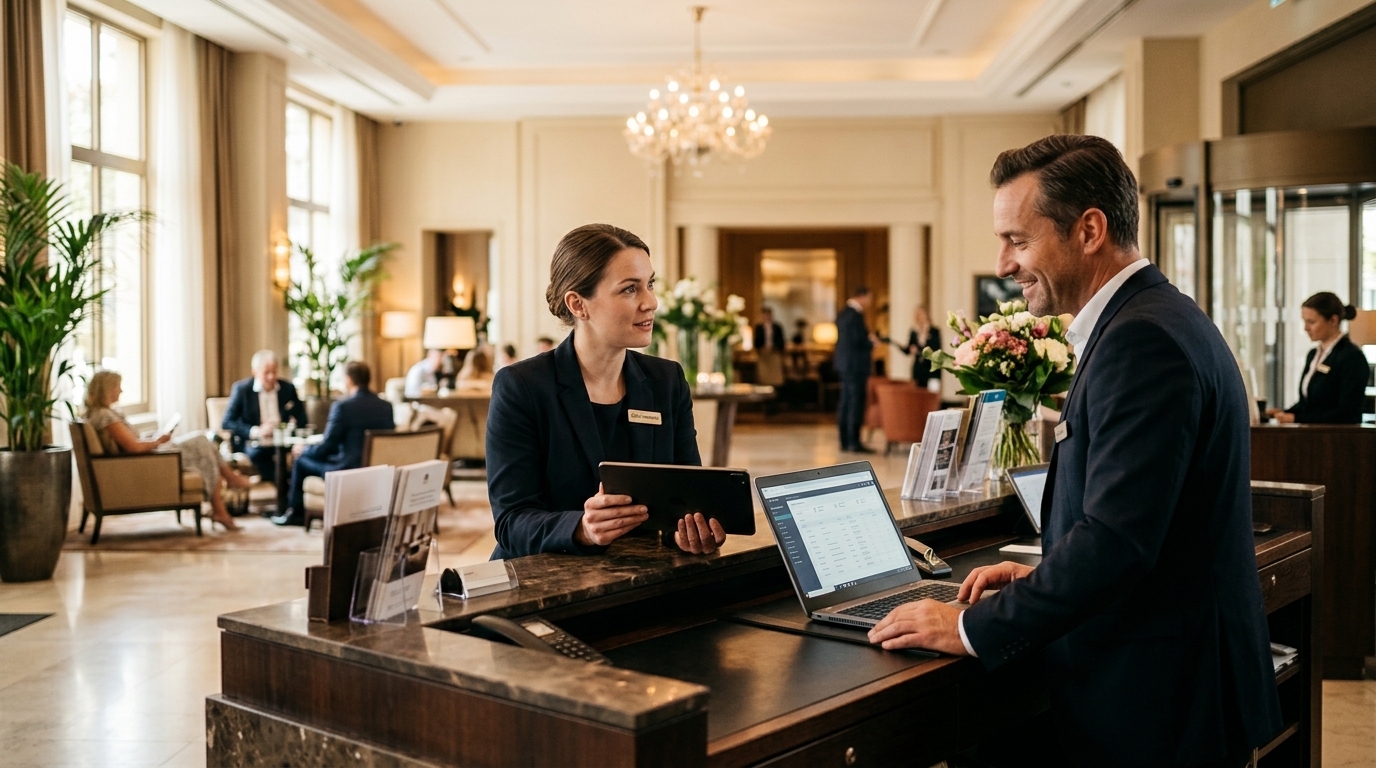
A few years ago, a hotel’s digital presence was limited to its corporate website and perhaps a proprietary TV channel. Today, guests expect to interact with the property across multiple touchpoints: they receive information on the lobby screen, check the restaurant menu from their phone, complete pre check-in before they arrive, request an extra towel via chat and rate their stay before leaving.
Each of those moments requires a technology solution. And this is where many hotels end up with a fragmented technology map: one provider for the guest app, another for the digital signage, another for buffet labels, another for the TV channel and, if they are lucky, some manual connector between them.
The result is predictable. Content becomes outdated because updating five different platforms takes twice the effort. Guest data does not flow between systems. And when something breaks, nobody quite knows whose responsibility it is.
The real problem of working with single-channel specialist providers
The hotel technology market is full of providers that excel at one specific thing. There are companies that produce excellent digital buffet labels but offer no signage or app solution. Others provide a highly polished guest webapp but no hardware capability whatsoever. Others specialise in interactive TV but do not touch the mobile world.
None of those solutions is inherently bad. The problem emerges when you try to connect them.
Integrations between platforms from different providers are costly to implement, fragile in the face of updates and dependent on commercial agreements that can break down. When provider A updates its API, the connector with provider B stops working. Meanwhile, the operations team is managing tickets with two separate support desks that point the finger at each other.
There is also a strategic factor that is frequently overlooked: scalability. A hotel that today only needs a webapp and buffet labels may, in twelve or twenty-four months, need lobby kiosks, a corporate app for the team or an AI chatbot to handle enquiries in multiple languages. If every new requirement means a new provider, the ecosystem becomes exponentially more complex and the technology debt grows along with it.
What it really means to manage everything from a single 360 CMS
The value proposition of a 360 CMS is not about having many features in one place. It is that all those features share the same content logic, the same guest data and the same management dashboard.
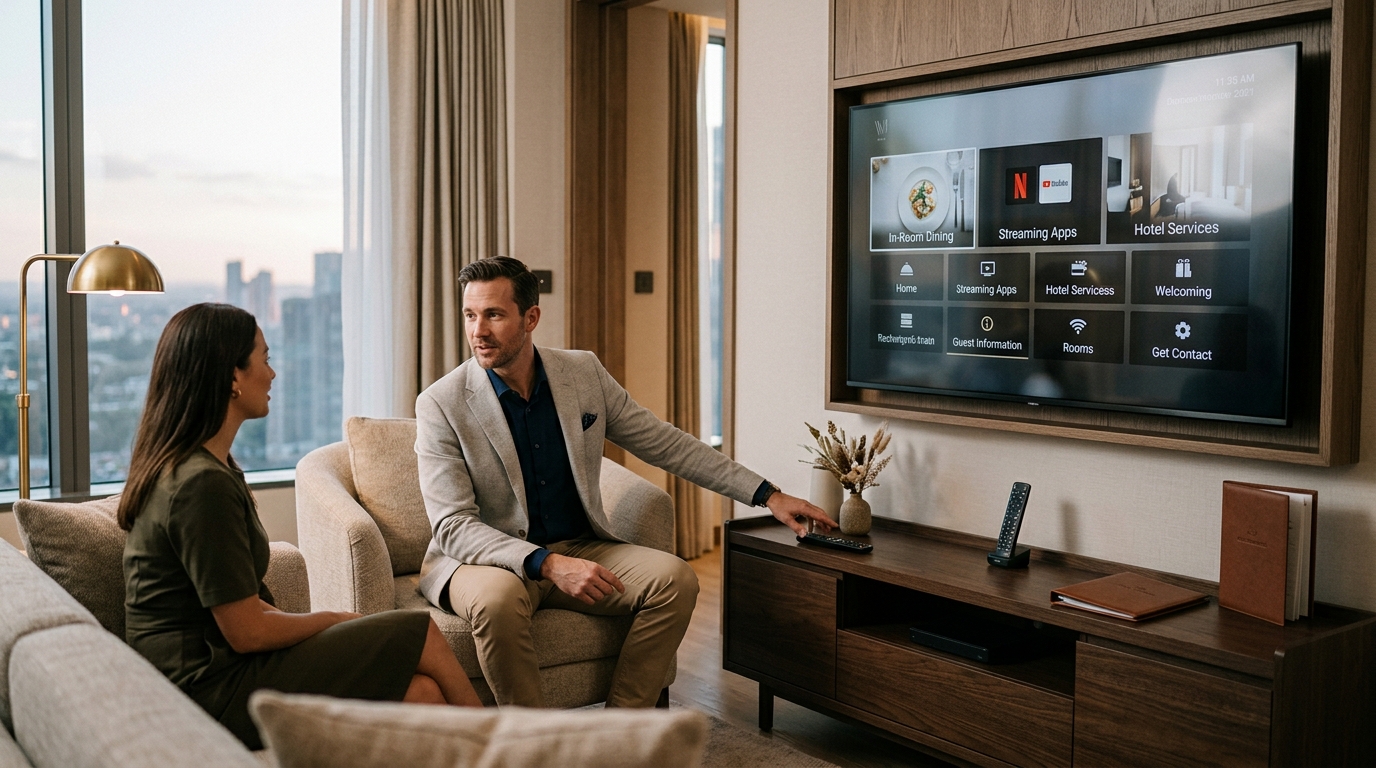
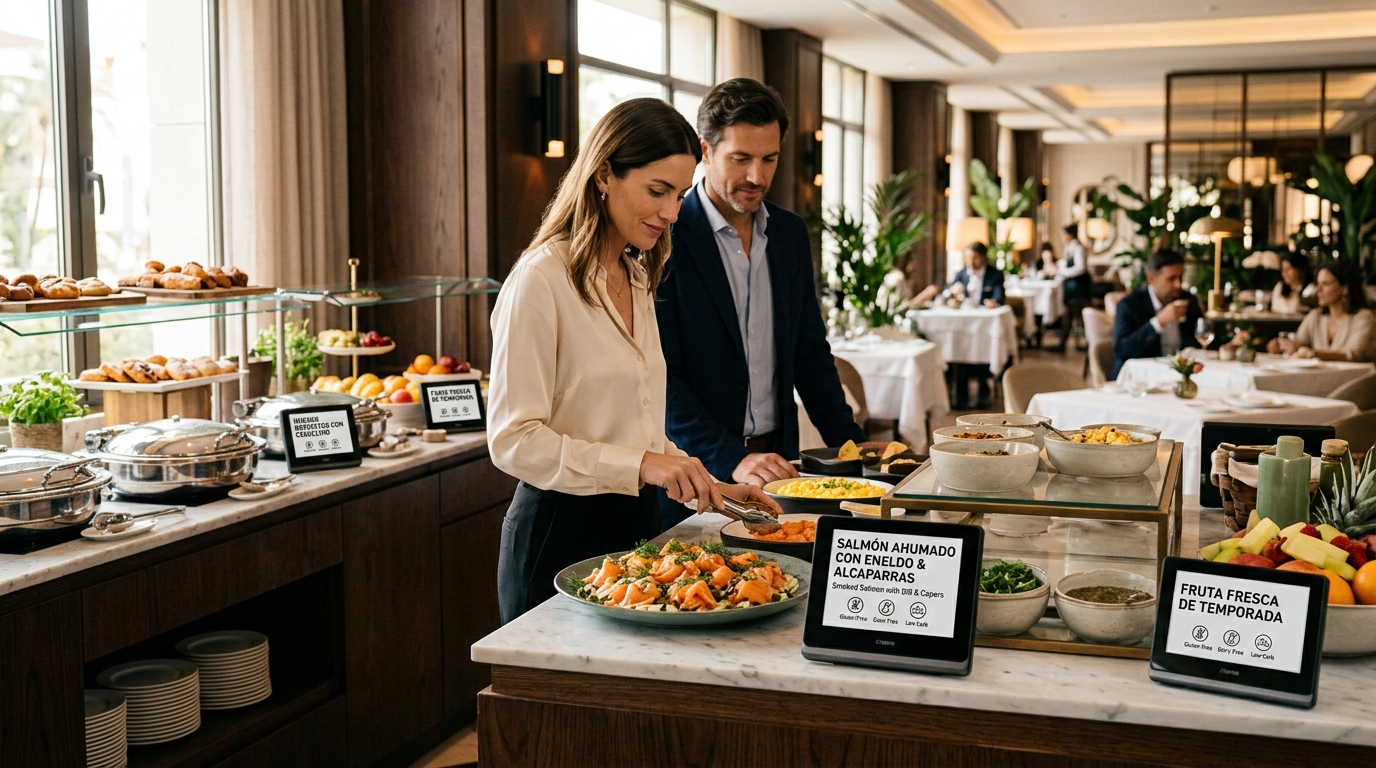
When you update the restaurant hours in Hoteligy, that change is automatically reflected in the guest webapp, on the Digital Signage screens in the corridor, on the digital buffet labels and in the Smart TV App in the rooms. One single action, every touchpoint updated. No duplication, no risk of a screen displaying outdated information.
The same applies to personalisation. If the system knows that a guest has booked a spa treatment, it can show them relevant reminders in their app, on the lobby kiosk as they walk past and on their television when they enter the room. That consistency across channels is impossible to achieve when each channel has its own provider and its own database.
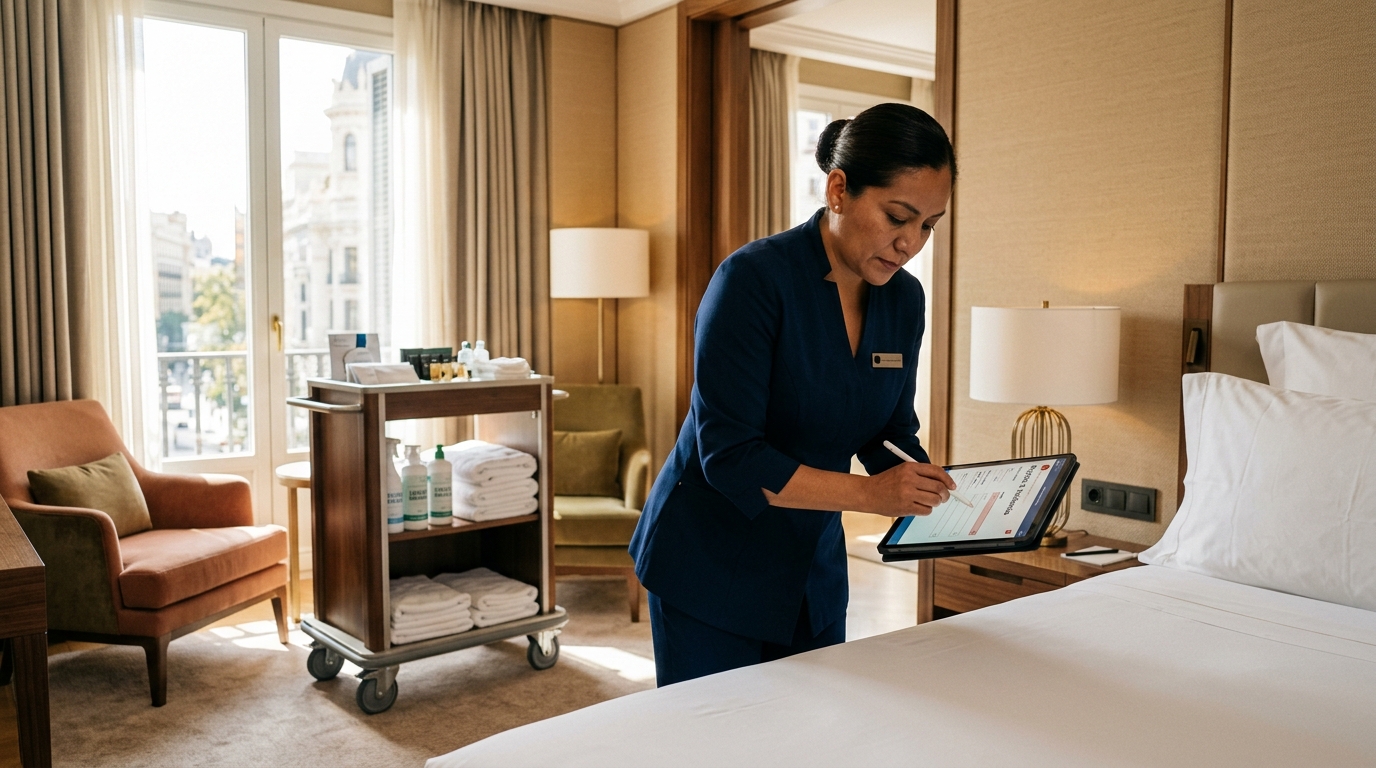
From an operational perspective, the marketing and operations team works with a single learning curve, a single support contact and a single contract. This has a direct impact on training costs, incident response times and the ability to react quickly to seasonal or scheduling changes.
How to scale the digital ecosystem without changing provider
One of the strongest arguments for choosing a 360 platform is friction-free scalability — and it is an argument best understood with a two-to-three-year perspective.
A hotel that starts with the guest webapp and the satisfaction survey module can, in the following season, add the corporate TV channel and interactive kiosks for the lobby. The year after, it can incorporate the AiChat to handle frequently asked questions in multiple languages with no additional burden on reception. Then, digital buffet labels when the restaurant is refurbished.
Every step happens within the same system. No data migrations. No new integration contracts. No training new staff on another platform. The team already knows how the CMS works, the content is already structured and the historical record of guest interactions remains intact.
This model is especially relevant for hotel chains. When several properties share the same CMS, centralised management of corporate content, brand consistency and comparative analysis across properties all become naturally possible — not as an added integration, but as a native feature of the system.
Hoteligy operates in more than 26 countries and works with chains such as Radisson, H10, Princess Hotels, Iberostar and Spring Hotels, precisely because this scalability model responds to the real needs of properties with complex operations and brand standardisation requirements.
Questions you should be asking your current provider (or the next one)
Before signing any technology contract, there are questions worth having on the table:
Can I manage all my digital channels from a single dashboard? If the answer is no, calculate how many hours per week your team spends duplicating content across systems.
What happens when I need to add a new channel or solution? If the answer involves a new provider or a bespoke integration, you already know what that will cost in eighteen months.
Does guest data flow across all modules? Real personalisation is only possible when the system has a unified view of the guest. If each tool has its own data silo, a personalised experience is impossible to scale.
Does the provider have experience with properties of my size and type? Managing the digitalisation of a 40-room boutique hotel is not the same as managing an 800-room resort with multiple food and beverage outlets, a spa and activities.
Conclusion
The decision about which technology to adopt in a hotel should not be evaluated solely on the basis of the immediate need. A system that solves today’s problem well but that in two years forces a costly migration or requires adding mutually incompatible providers is not a sound long-term investment.
A 360 CMS capable of covering all digital touchpoints — app, hardware, TV, chatbot, signage — from a single platform not only reduces the day-to-day operational burden. It protects the hotel’s technology investment and ensures that every step of digital growth is a step forward, not a new negotiation with a new interlocutor.
Hotel digitalisation is not a fixed snapshot. It is a continuous process. And it makes far more sense to undertake that journey with a provider that already knows your operations, your data and your objectives.
Would you like to see how a 360 CMS would fit into your property’s operations? Request a personalised demo at hoteligy.com/demo