Digital Signage has ceased to be just a glowing sign in the lobby. Today, it is a revenue, operational, and brand channel that, when poorly managed, becomes visual noise; when well-managed, it boosts restaurant ADR, fills the spa during off-peak hours, and reduces front desk workload.
Most hotels have screens installed, but few exploit them as a revenue asset. The problem is not the hardware: it is the lack of a targeted, measurable content strategy connected to the rest of the hotel’s digital ecosystem.
The True Cost of Poorly Managed Signage
A static screen network—displaying the same welcome loop for months—does not just leave revenue on the table. It causes visual blindness for the guest, damages brand perception, and forces reception staff to keep answering questions that the screen should be resolving.
In practice, we see three recurring patterns in hotels that have not yet optimized their digital signage:
- Outdated content: restaurant hours from last season, events that have already taken place, or expired promotions. Every visible error erodes trust.
- Generic messages: the same content in the lobby, elevators, pool area, and buffet entrance, without considering the guest’s context at each touchpoint.
- Zero measurement: no data on which time slot, creative asset, or CTA generates actual bookings in the restaurant or spa.
The result is predictable: the hotel’s GOP does not reflect the investment in screens, and the general manager rightly questions the project’s ROI.
What Data You Must Analyze Before Redesigning Content
Optimizing digital signage is not a creative exercise; it is an analytical one. Before changing a single asset, you need three layers of data:
1. Occupancy and guest profile by day. A Monday with 70% business travelers is not the same as a family Saturday at 95% occupancy. Content must rotate accordingly: on Monday, push late check-out and room service; on Saturday, promote the kids’ club and sunbed bookings.
2. Demand curves by outlet. What time does the restaurant fill up? When are there empty slots in the spa? Identify off-peak windows—typically 11:00-13:00 in the spa, 14:30-17:00 in the à la carte restaurant—and use them as targeted promotion windows.
3. Conversion of existing digital channels. If you already operate with a Guest WebApp, you have data on which services are booked most, which carousel converts best, and what pricing works. This same intelligence must feed your screens.
Without these three inputs, any new content on your signage will be a blind bet.
Segmentation by Zone: Every Screen, One Function
The most expensive mistake is treating all screens as a single channel. They are not. Each location has a guest in a different state of mind and, therefore, a different business objective.
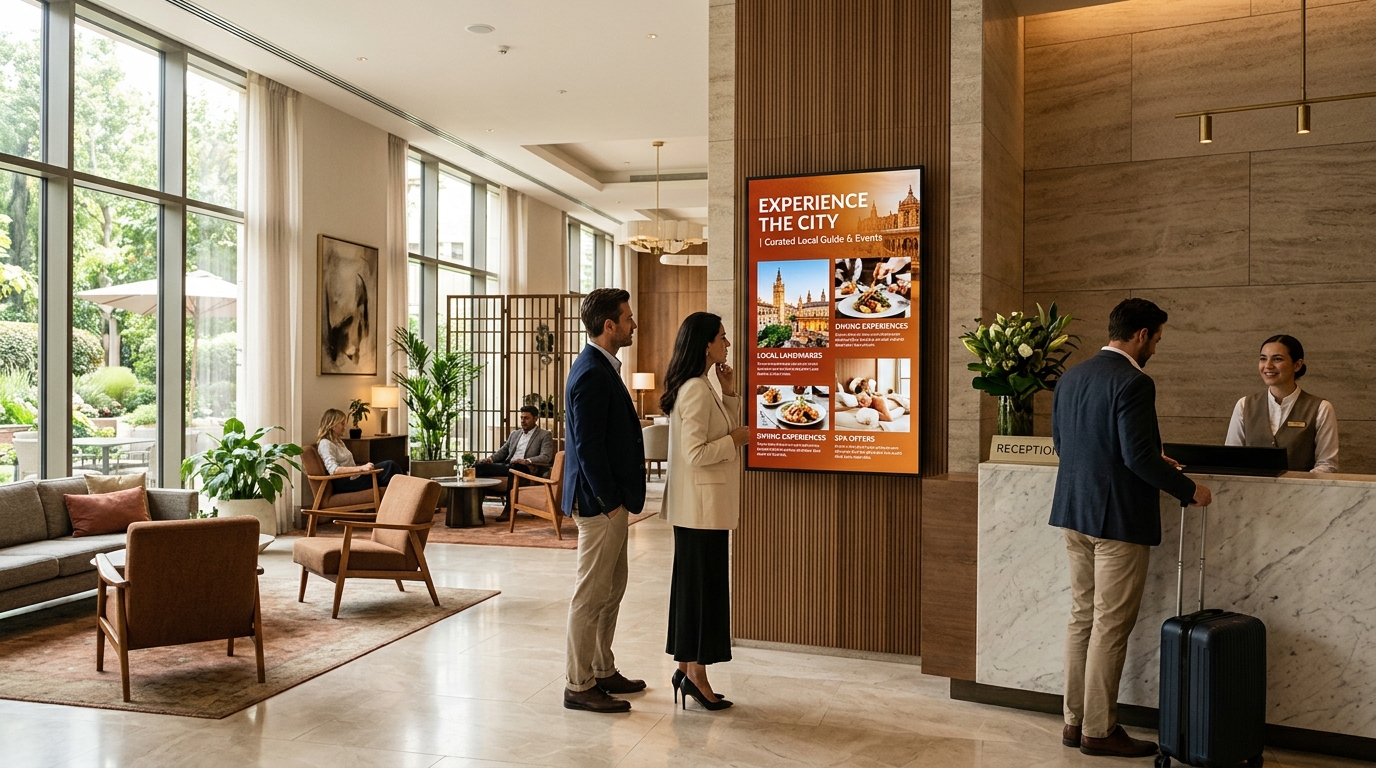
Lobby and Reception
The guest has just arrived (or is about to leave). Objective: reduce front desk queues and plant the first spending intent.
- Personalized welcome with daily events and weather forecast.
- Push for PreCheck-in Online for future stays.
- Promotion of the spa and restaurant with a direct QR code for booking.
- Real-time operational information: opening hours, outlet locations, WiFi.
Elevators and Hallways
Short viewing times (15-40 seconds). A single, highly visual message with an unambiguous CTA works best here.
- Only one promotion per loop. One discount. One QR code.
- Rotation by time of day: breakfast in the morning, dinner in the late afternoon.
Restaurant and Buffet Entrances
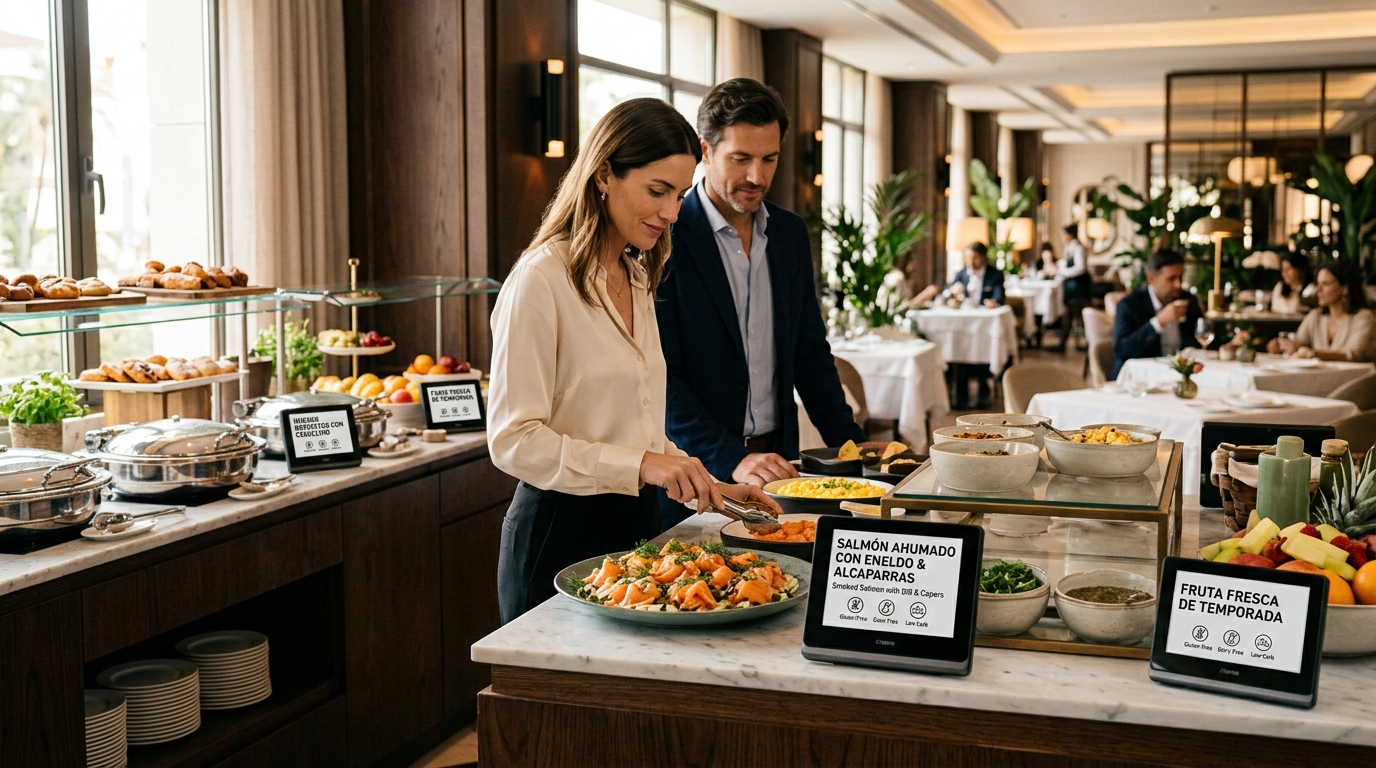
This is where you decide the average ticket. Combining signage with digital buffet labels allows you to display allergens, chef recommendations, and wine pairings in real time, boosting premium drinks or high-margin desserts.
Spa, Pool, and Wellness Areas
Where the guest is relaxed and open to spending. Promotions for treatments, premium sunbed bookings, and express massages during off-peak hours.
Four Concrete Levers to Drive Revenue This Season
The following are actionable changes, not theory. They can be implemented in weeks.
1. Dynamic Pricing Visible on Screen
If your spa has 30% occupancy between 11:00 and 13:00, launch a specific loop during that window with a reduced rate for that time slot. A guest walking down the hallway at 11:15 sees the offer valid until 13:00 and scans it. Conversion increases because the offer is time-sensitive and contextual.
2. Cross-Selling Between Outlets
A guest who books a dinner at the restaurant should see, on their way from the room, a promotion for a premium drink or tasting menu. Synchronize screen content with your restaurant booking operations to boost the average ticket before they even sit down.
3. Content by Language Based on Nationality Mix
If your PMS shows that this week 40% of guests are German and 30% are British, the signage must rotate creatives in those languages with proportional weight. It is still surprising to see hotels with 60% international guests displaying content only in Spanish.
4. Metrics per Screen, Not per Network
Assign a unique QR code or a different promo code to each zone. At the end of the month, you will know which screen generates bookings, which one is merely decorative, and where you urgently need to redesign content.
Integration with the Rest of the Digital Ecosystem
An isolated screen is worth very little. A screen connected to your PMS, guest app, and chatbot is worth a lot. When a unified CMS manages signage, WebApp, Smart TV, and kiosks from a single point, two structural changes occur:
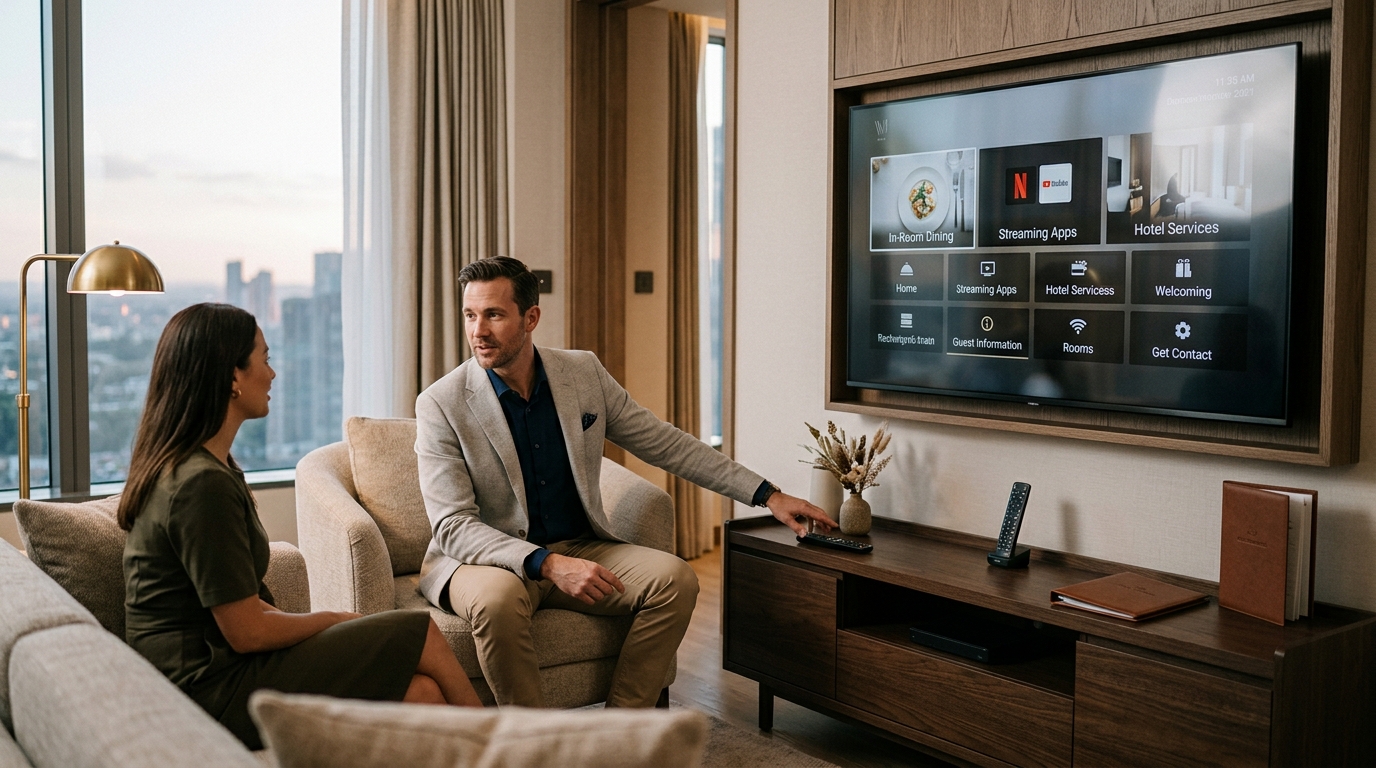
Message Consistency. The Sunday brunch promotion appears in the lobby, elevator, WebApp, and in-room TV channel with the same creative, same price, and same CTA. The guest sees it three or four times during the day. Conversion multiplies.
Operational Speed. Changing a schedule, launching a flash promo, or removing a canceled event is done once and propagates to all touchpoints in minutes. Without this, hotel marketing gets bogged down in maintaining parallel channels.
Those who manage signage as an isolated silo will always lag behind the guest. Those who orchestrate it from a central CMS turn every screen into a point of sale.
How to Measure If the Redesign Is Working
Three KPIs are enough to audit the health of your signage quarter by quarter:
- Attributed bookings per screen: via unique QR codes or promo codes per zone. If a screen generates nothing in 30 days, change the content or location.
- Reduction in front desk inquiries regarding topics resolved by signage (schedules, locations, events). This is measured in the first two weeks following the redesign.
- Incremental average ticket in outlets during time slots where they were specifically promoted on screen vs. slots without promotion.
If all three move in a positive direction, the ROI of your signage is documented and defensible to management.
Conclusion
Hotel digital signage only works when it stops being decoration and becomes revenue infrastructure. This requires three things: zone-based segmentation, content fueled by real hotel data, and integration with the rest of your digital channels under a single CMS.
Hotels that take this step recover their investment in screens within a single season and, above all, stop fighting outdated content every morning. The difference between a signage network that sells and one that decorates is not the technology: it is how it is managed.
Want to see how Hoteligy can orchestrate your digital signage alongside the rest of your hotel’s digital channels? Request a personalized demo and we will show you real cases with conversion data per screen.