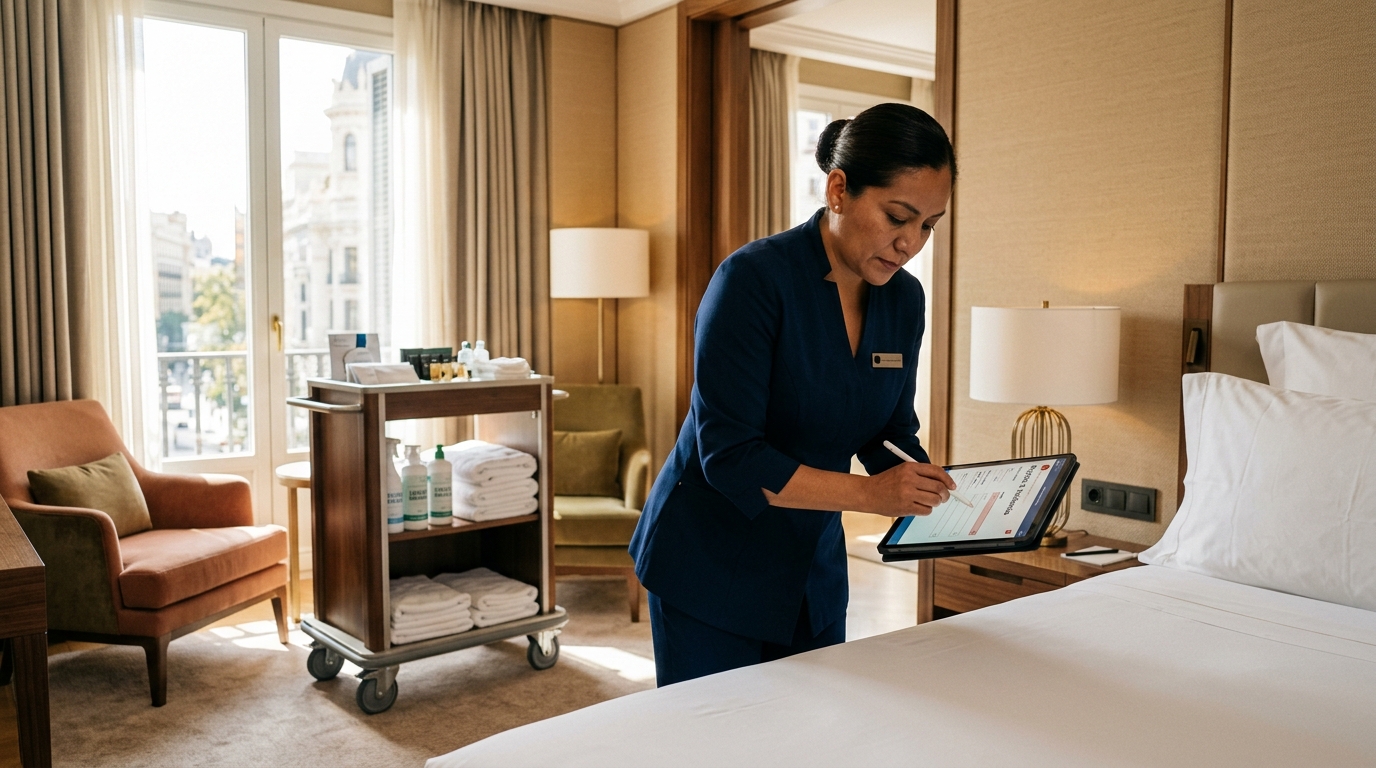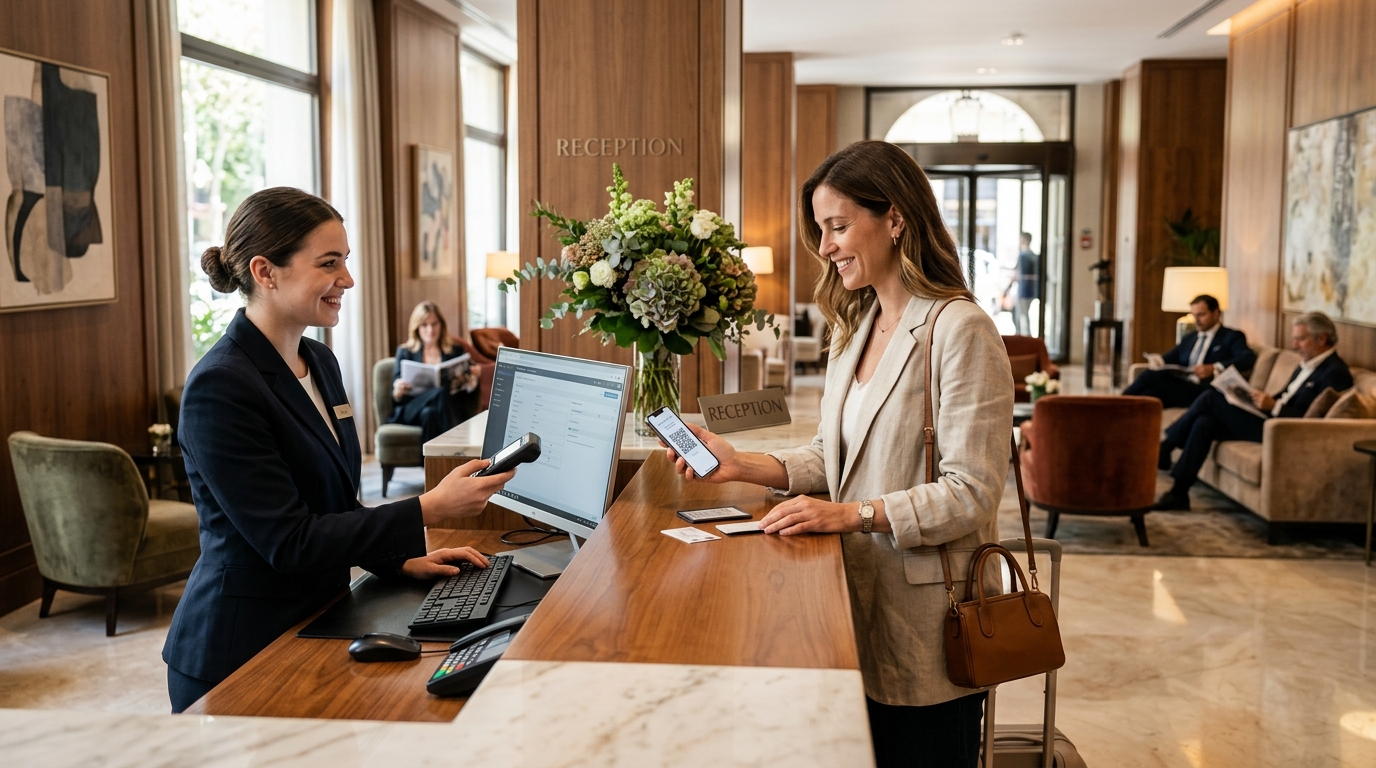
Queues at the front desk at four in the afternoon remain one of the biggest NPS destroyers in both resort and city hotels. The problem is not the guest’s arrival time: it is a check-in process designed for paper, not for 2026.
If your front desk manages peaks of 80-120 arrivals concentrated within two hours, this article is for you. We are going to define what “check-in times” are, why they directly impact revenue and satisfaction, and how Online PreCheck-in changes the operational equation.
What are hotel check-in times and why do they matter?
The term “check-in time” has two interpretations that should be separated:
1. Official check-in time. The time from which a room is available for the guest, usually between 14:00 and 16:00. This is a contractual variable linked to housekeeping operations.
2. Actual processing time. The minutes a guest takes from arriving in the lobby to entering their room. This is where the real problem lies: the international average is around 8-12 minutes per guest, and it spikes to 20+ minutes during peak times.
The difference matters because the perception of the check-in time is defined by the second metric, not the first. A guest waiting 25 minutes in line at 15:30 does not remember that their room was ready at 14:00. They remember the wait.
The hidden cost of a slow check-in
- NPS: first impressions carry disproportionate weight in post-stay surveys.
- Human resources: peaks force overstaffing at the front desk.
- Lost upselling: an overwhelmed receptionist does not offer upgrades or ancillaries.
- Online reviews: “we waited 30 minutes to check in” is one of the most repeated complaints on Booking and Google.
The shift: from check-in to PreCheck-in
Online PreCheck-in shifts most of the administrative process to the pre-arrival period. Instead of capturing data at the front desk, the guest provides it from their mobile device between booking confirmation and the day of arrival.
What exactly is digitized?
A well-designed PreCheck-in Online process covers:
- Data of all guests in the reservation (not just the main booker).
- ID/Passport upload and image capture for traveler registration.
- Digital signature of the registration form with legal validity.
- Estimated Time of Arrival (ETA).
- Preferences: bed type, pillow choice, allergies, special occasion.
- Tokenized credit card for guarantee or pre-authorization.
- Acceptance of hotel policies.
- Cross-selling: upgrades, parking, transfer, late check-out, Spa services, or restaurant reservations.
When the guest arrives, the front desk only needs to validate identity and hand over the key. The actual processing time drops from 8-12 minutes to 1-2 minutes.
How to implement it in your hotel
Implementing PreCheck-in is not just about “putting a form online.” It requires aligning technology, operations, and communication. These are the critical points.
1. Integration with the PMS
Without two-way integration with your PMS, PreCheck-in generates double work: the receptionist ends up re-entering data. The platform must write directly to the reservation, attach documents to the profile, and update the ETA in real time. Hoteligy has native integrations with the main PMS on the market.
2. Communication at the right time
The email or WhatsApp with the PreCheck-in link should be sent 48-72 hours before arrival. Before that, the guest ignores it. After that, they are already in transit. A reminder 24 hours before to those who have not completed the process increases the adoption rate from 40% to 65-75%.
3. Mobile-first and frictionless design
The form should be completed in less than 3 minutes. Every optional field you add reduces the completion rate. Prioritize legally mandatory fields and a couple of high-value personalization fields. The rest can be captured during the stay from the Guest WebApp.
4. Operational plan at the front desk
Set up an express lane or a dedicated desk for guests with completed PreCheck-in. Signage in the lobby is key: if the guest does not see the benefit, they will not complete the process next time.
5. Continuous measurement
KPIs to monitor monthly:
- % of bookings with completed PreCheck-in.
- Average processing time at the front desk (with and without PreCheck-in).
- Arrival-specific NPS.
- Ancillary revenue generated during the PreCheck-in flow.
Frequently asked questions about check-in times
Is it legal to sign the registration form online? Yes, in Spain and most EU countries, the digital signature is valid for traveler registration as long as identification and data retention requirements are met. Hoteligy complies with Royal Decree 933/2021 and automatic submission to the SES Hospedajes platform.
What percentage of guests actually complete the PreCheck-in? It depends on the segment and communication. Resort hotels with well-designed communication exceed 70%. Short-stay city hotels hover around 50-60%.
Does it replace the receptionist? No. It frees them up. The front desk stops being a transaction counter to become a point of welcome, upselling, and resolution. The role gains value, it does not lose it.
Does it work with groups and corporate bookings? Yes, although it requires a specific flow where a group leader manages the data of the rest of the guests.
What about guests who prefer traditional check-in? That option must always exist. PreCheck-in is not forced, it is incentivized. Data shows that, once tried, most guests repeat it.
Conclusion
Check-in times are no longer a fixed variable of hotel operations: they are an indicator of digital maturity. Reducing actual processing time from 10 minutes to 2 minutes impacts NPS, staffing costs, and ancillary revenue simultaneously.
Online PreCheck-in is not an emerging technology; it is a market standard in chains competing on experience. The question for 2026 is not whether to implement it, but with which platform and with what depth of integration.
Want to see how Hoteligy’s Online PreCheck-in works with your PMS? Request a personalized demo at hoteligy.com/demo and we will show you a real flow with data from your hotel type.