Housekeeping remains, in many hotels, the last analog bastion of operations. Paper sheets, radio calls, Excel sheets at the end of the shift, and a front desk that does not know in real time which rooms are ready to sell.
While revenue management is optimized by the minute and marketing is measured by micro-conversions, the housekeeper continues to cross off rooms with a pen. This gap costs money: forced late check-outs, unnecessary upgrades, avoidable complaints, and a GOP that is eroded by hidden costs. Let’s look at how to change this in 2026.
The state of housekeeping in today’s hospitality industry
When we talk about housekeeping, we refer to the department responsible for cleaning, light maintenance, and setting up rooms and common areas. It is the area with the largest operational staff in the hotel and the one that most impacts two sensitive KPIs: room turnover speed and cleanliness scores in reviews.
The problem is that most hotels continue to manage this department with tools from 30 years ago:
- Assignment sheets printed in the morning.
- Communication via walkie-talkie or group WhatsApp.
- Technical incidents written down by hand and verbally transferred to maintenance.
- Reception calling the housekeeper every 15 minutes to find out which rooms are “OK”.
The result: loss of information, waiting times at check-in, incidents that take days to resolve, and an overwhelmed team that cannot demonstrate its real productivity.
The three most expensive bottlenecks
- Lag between real status and status in PMS. A clean room that is not marked on time blocks the sale of that inventory.
- Orphan incidents. A blown light bulb that the maid reports verbally, maintenance does not write down, and the guest discovers at night.
- Lack of traceability. When there is a complaint about cleanliness, nobody knows who cleaned that room or at what time.
What it means to digitalize housekeeping
Digitalizing housekeeping is not about buying tablets. It is about connecting three information flows that currently run through different channels:
- Room assignment and status (maid ↔ housekeeper ↔ reception).
- Incident reporting (maid ↔ maintenance).
- Guest requests affecting the room (guest ↔ housekeeping).
When these three flows live in the same system, measurable things happen: the average room setup time drops, rooms are sold sooner, incidents are closed on the same day, and the housekeeper stops being a call center to go back to supervising quality.
Key concepts to keep in mind
- Digital room sheet: electronic record of the status (dirty, cleaning, clean, inspected, out of service) updated in real time.
- Incident ticket: work order with photo, location, priority, and SLA automatically assigned to the correct technician.
- Guest → operations flow: a customer request (extra towels, hypoallergenic pillow) goes directly into the housekeeping queue without passing through reception.
The solution: connecting housekeeping with the rest of the hotel
This is where Hoteligy’s Peticiones e Incidencias module becomes the central piece. It does not replace the PMS, it complements it: it manages everything that happens inside the operational cycle of the room and the hotel.
How it works in practice
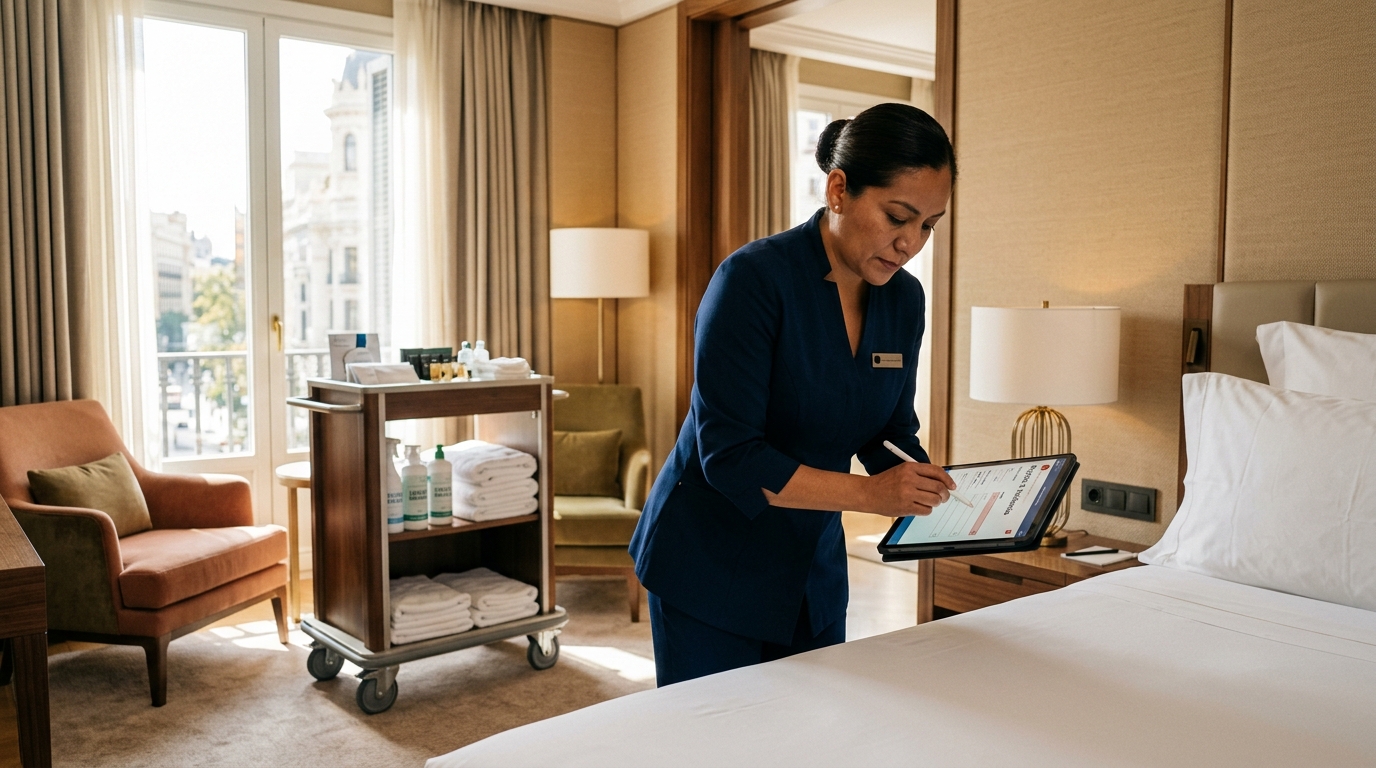
1. The maid enters the room. She scans a QR code or presses the room button on her tablet/mobile. The status automatically changes to “cleaning” and is visible at reception.
2. She detects an incident. Photo + category (plumbing, electricity, furniture) + exact location. The ticket reaches the technician on duty with a priority calculated according to the expected occupancy of the room.
3. She finishes cleaning. She marks “ready for inspection”. The housekeeper receives the notification and validates it during her rounds. Reception now has the room available to sell.
4. The guest requests something from the Guest WebApp. An extra pillow at 22:30. The request enters as a ticket in the night housekeeping queue, it does not get lost in a phone call.
What changes for each role
- Maid: less administrative time, more time cleaning. Reports incidents in 20 seconds.
- Housekeeper: real-time dashboard of all floors. Decides where to reinforce without walking for 8 hours with a piece of paper.
- Maintenance: prioritized list of tickets with photos. Does not depend on anyone’s memory.
- Reception: knows in real time which room is ready. Reduces check-in wait times and stops bothering floors every 10 minutes.
- Management: productivity data per maid, average time per room, recurring incidents by type and by hotel wing.
How to apply it in your hotel: roadmap
You don’t need a 6-month transformation. A realistic implementation is done in weeks if approached in phases.
Phase 1: Real-time room status (weeks 1-2)
Replace paper sheets. Every status change is registered from the mobile device. Integration with PMS so reception sees the available inventory updated.
Phase 2: Incident tickets (weeks 3-4)
Migrate all technical incidents to the system. Define SLAs by category (urgent: 2h, normal: 24h, scheduled: 72h). Measure closure times.
Phase 3: Connection with the guest (week 5+)
Activate request entry from the Guest WebApp and, optionally, from the AiChat. The guest requests, the ticket automatically enters the correct team.
Phase 4: Analytics and continuous improvement
Start reading the data: which rooms generate the most incidents? Which maids need reinforcement? What types of breakdowns are recurring and reveal a structural problem?
Best practices that make a difference
- Train the staff in the language they speak. Most floor maids are not digital natives in Spanish; the interface must be multilingual and visual.
- Reward use, not compliance. Making the tool ease their work (fewer steps, fewer radios) is what drives real adoption.
- Measure before and after. Average time per room, % of incidents closed in 24h, and cleanliness NPS. Without a baseline, there is no business case.
- Connect with surveys. Crossing data from the Encuestas de Satisfacción module with housekeeping traceability allows you to identify exactly where the friction is.
Conclusion
Digitalizing housekeeping in 2026 is not a technological issue, it is an operational one. The hotel that continues to manage floors with paper is leaving rooms unsold in the morning, accumulating minor incidents that turn into negative reviews, and losing visibility over the real productivity of its largest department.
The good news is that the implementation curve is short and the return is seen in the first weeks: fewer calls to reception, fewer lost tickets, more effective room turnover, and a team that can finally demonstrate what they do.
Want to see what this would look like in your hotel? Explore a real case at hoteligy.com/demo