The in-room television remains one of the most underutilized touchpoints in the hotel. In 2026, choosing a hotel TV solution is no longer about installing screens: it is about integrating the TV into the digital ecosystem that drives ancillary revenue, NPS, and operational efficiency.
In this article, we review what hotel TV solutions are, what options exist today, how to evaluate them, and which criteria to prioritize before signing a 5-year contract with a provider.
What is a hotel TV solution
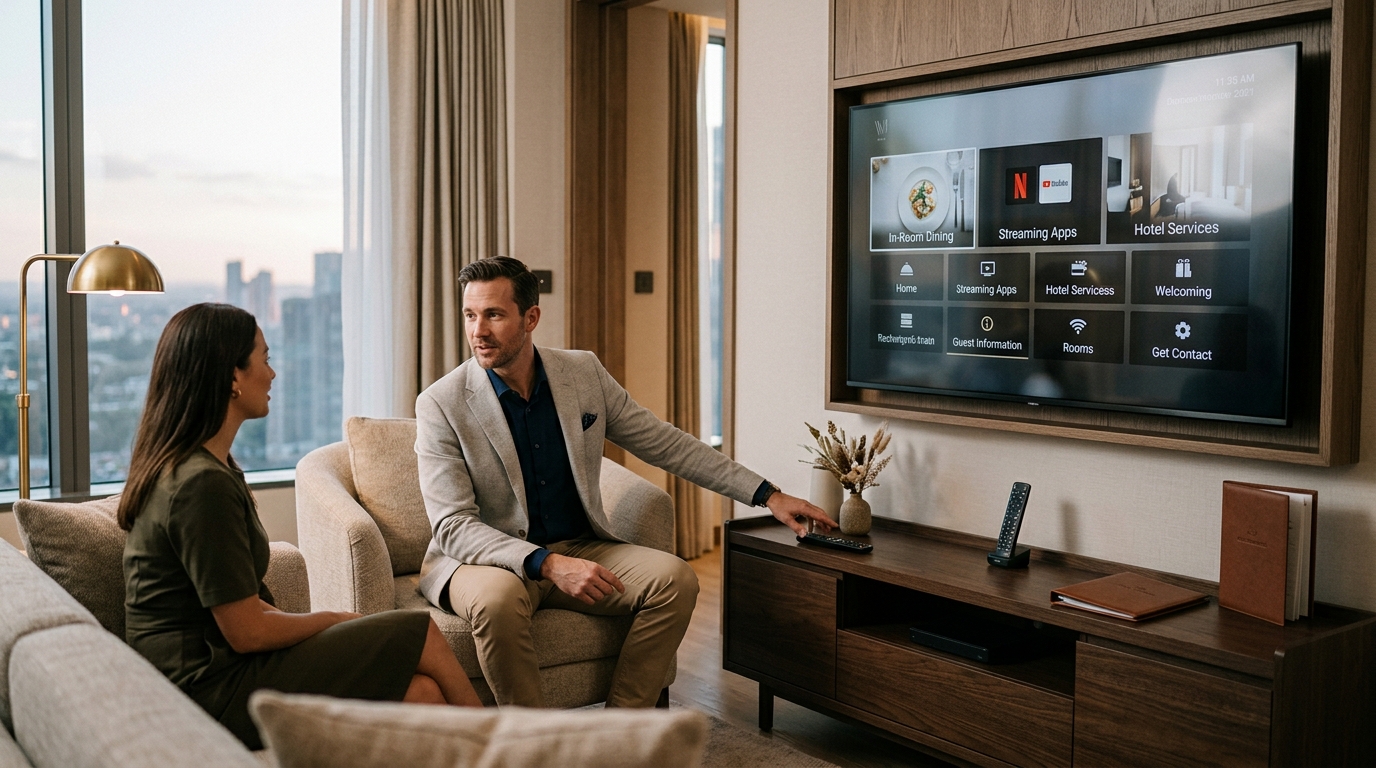
A hotel TV solution is the combination of hardware, software, and content that manages the guest’s television experience: from the in-room TV set to the system that delivers channels, applications, hotel information, and on-demand content.
In practice, it groups four layers:
- Hardware: Televisions (usually hospitality-grade Smart TVs) and, in some cases, set-top boxes or Chromecast/Cast devices.
- Middleware / IPTV: The system that distributes signal and content over the hotel’s network.
- User Interface: The portal or launcher that the guest sees when turning on the TV.
- CMS: The back-office from which channels, promotions, languages, and content are managed.
When implemented well, the TV shifts from being a sunk cost to becoming an active channel for communication, upselling, and satisfaction.
Why reopen the debate in 2026
Three factors have changed the playing field compared to classic installations:
1. The real cost of coaxial cabling. IPTV solutions over existing IP networks eliminate a large part of the civil works. In partial renovations, this reduces CAPEX and installation times.
2. Convergence with the guest’s mobile device. Guests arrive with Netflix, Prime, Disney+, or Spotify on their phones. If the TV does not allow secure casting or personal login, it is perceived as obsolete from the very first minute.
3. The TV as a screen for the digital ecosystem. The best hotel TV solutions are no longer islands: they connect with the Guest WebApp, the digital menu, Room Service Digital, or satisfaction surveys.
Types of hotel TV solutions
Before comparing providers, it is useful to be clear about the available architectures:
Classic IPTV
Signal distribution over a dedicated IP network, with middleware on a local server. High reliability, total control, but heavier to maintain and update.
Chromecast / Casting
Focused on allowing the guest to cast from their mobile device. Low CAPEX, perceived as a modern experience, but limited as a hotel channel to promote its own services.
Smart TV App (Tizen / webOS / Android TV)
A native application that runs directly on the Smart TV, without a set-top box. It is the option with the best balance between cost, maintenance, and dynamic content capacity. The Smart TV App by Hoteligy follows this model.
Hybrid Solutions
They combine a Smart TV App with casting and, optionally, linear channels via IPTV. This is where most medium and large chains are moving.
Criteria for choosing the best solution in 2026
These are the points that should be on the table in any evaluation:
Integration with the PMS. The TV must recognize the guest, display their language, their name, and their booked services. If the provider does not have a stable integration with Opera, Protel, Mews, or the PMS you use, it is a red flag.
Centralized multi-property management. For chains, being able to manage content for 5, 20, or 100 hotels from a single CMS is non-negotiable. In Hoteligy, this is resolved with the CMS 360, which unifies TV, digital signage, and webapp in a single panel.
Dynamic and multi-language content. Daily menus, activities, spa information, weather forecast, events. Everything should be editable by marketing without depending on IT.
Monetization. Does the solution allow promoting the à la carte restaurant, the spa, excursions, or late check-out? The Canal TV must feed ancillary revenue, not just inform.
Secure casting. Isolated sessions per room, automatic deletion at check-out, and compatibility with the main OTT platforms.
Total Cost of Ownership (TCO), not just purchase price. Includes licenses, maintenance, updates, support, and hardware replacement cycle. A cheap solution in year 1 can be expensive in year 5.
Accessibility and compliance. Subtitles, voice control, or adapted navigation are starting to become regulatory requirements in several European markets.
How to apply it: a practical roadmap
If you are evaluating renewing or deploying a hotel TV solution, this is a reasonable approach:
1. Audit the current inventory. What TVs do you have? What operating system? How old are they? Many hotels discover they already have hospitality Smart TVs compatible with app-based solutions, without needing to change hardware.
2. Define priority use cases. A holiday resort (where the focus is on activities, restaurants, and spa) is not the same as an urban business hotel (where casting, local information, and express check-out matter).
3. Critical integrations. List the systems the TV must talk to: PMS, restaurant POS, spa booking system, direct channel. Check the provider’s actual integrations before signing.
4. Pilot in one property or floor. Before a massive rollout, validate in a controlled environment for 60-90 days. Measure adoption, support tickets, uptime, and guest feedback via surveys on the TV or webapp.
5. Rollout with a content plan. Technology is only 30%. The other 70% is having live content: weekly promotions, events, buffet updates. Without a content team, any hotel TV solution ends up outdated in three months.
Frequently Asked Questions
Do I need to change all the televisions? Not always. If you have recent hospitality Smart TVs (Tizen, webOS, Android TV), an app-based solution can be deployed without replacing the inventory.
How much does a hotel TV solution cost? It depends on the number of rooms, existing hardware, and active modules. App-based solutions have significantly lower CAPEX than traditional IPTV.
Can I integrate the TV with my guest webapp? Yes, and it is highly recommended. Letting the guest order room service from the TV or from their mobile phone with the same experience multiplies conversion.
What about Netflix, Prime, and others? Secure casting is the standard. The guest logs in with their account, watches the content, and at check-out, the session is deleted.
Conclusion
Choosing a hotel TV solution in 2026 is a strategic decision, not a technical one. The right TV integrates with the rest of the digital ecosystem, generates measurable ancillary revenue, and updates without depending on an external provider every time marketing wants to launch a promotion.
The common mistake is treating it as an isolated IT project. The success lies in understanding it as just another screen of the hotel’s unified CMS, alongside signage, totems, webapp, and direct channel.
Want to see how Hoteligy’s Canal TV and Smart TV App work integrated with the rest of the ecosystem? Request a personalized demo at hoteligy.com/demo.