Managing 8 different providers for WebApp, digital signage, TV, chatbot, and booking modules drains time, budget, and brand consistency. Technological fragmentation is currently one of the biggest obstacles to scaling the digital guest experience without skyrocketing the TCO.
The Hoteligy CMS addresses this specific problem: a single platform that centralizes all the hotel’s digital touchpoints and associated operational modules. In this article, we break down what it includes, how chains like Radisson, H10, Iberostar, or Princess Hotels use it, and what results you can expect in ancillary RevPAR and operational efficiency.
The Real Cost of Operating with a Fragmented Stack
Most medium and large hotels maintain between 6 and 12 parallel digital tools: an agency for the app, another provider for signage, a third for the chatbot, another for surveys, and another for spa bookings. Each with its own CMS, login, maintenance contract, and invoice.
This translates into three hidden costs that rarely appear on the P&L but impact GOP:
- Staff Operational Cost: updating the buffet menu across 4 different systems (TV, signage, WebApp, labels) consumes weekly hours from the F&B and marketing teams.
- Loss of Brand Consistency: misaligned fonts, colors, and messages across channels reduce the effect of in-stay campaigns.
- Data in Silos: without a single repository of guest behavior, upselling is based on intuition rather than actual usage patterns.
A 360 CMS eliminates all three pain points by converging content, modules, and data into a single backend.
What the Hoteligy 360 CMS Includes
The platform is organized into two layers: solutions (the channels through which the guest consumes) and modules (the operational functionalities activated as needed).
Solutions Layer (Touchpoints)
- Guest WebApp: access without downloads via QR or WiFi, the main entry point for the guest during their stay.
- Digital Signage for common areas, lobby, and restaurants.
- Interactive Totems for check-in, information, and self-service.
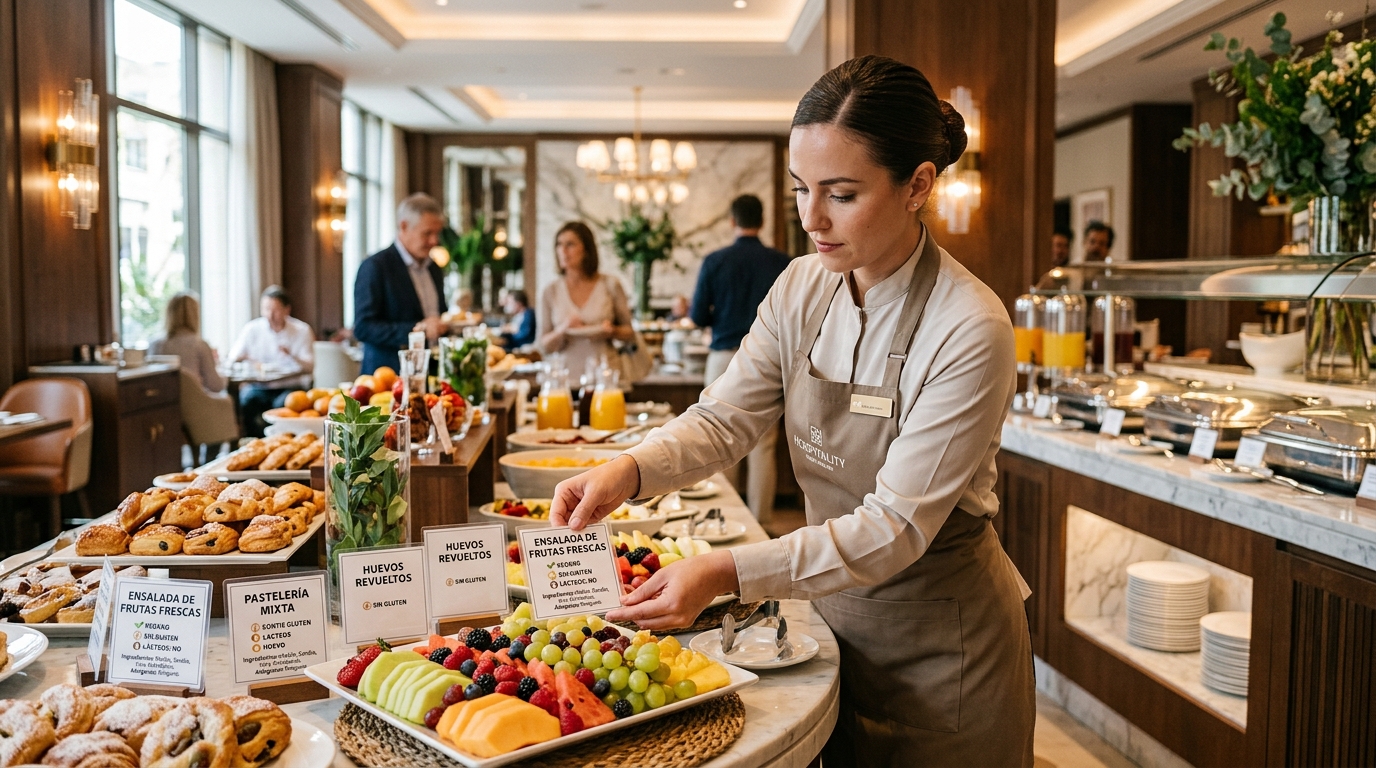
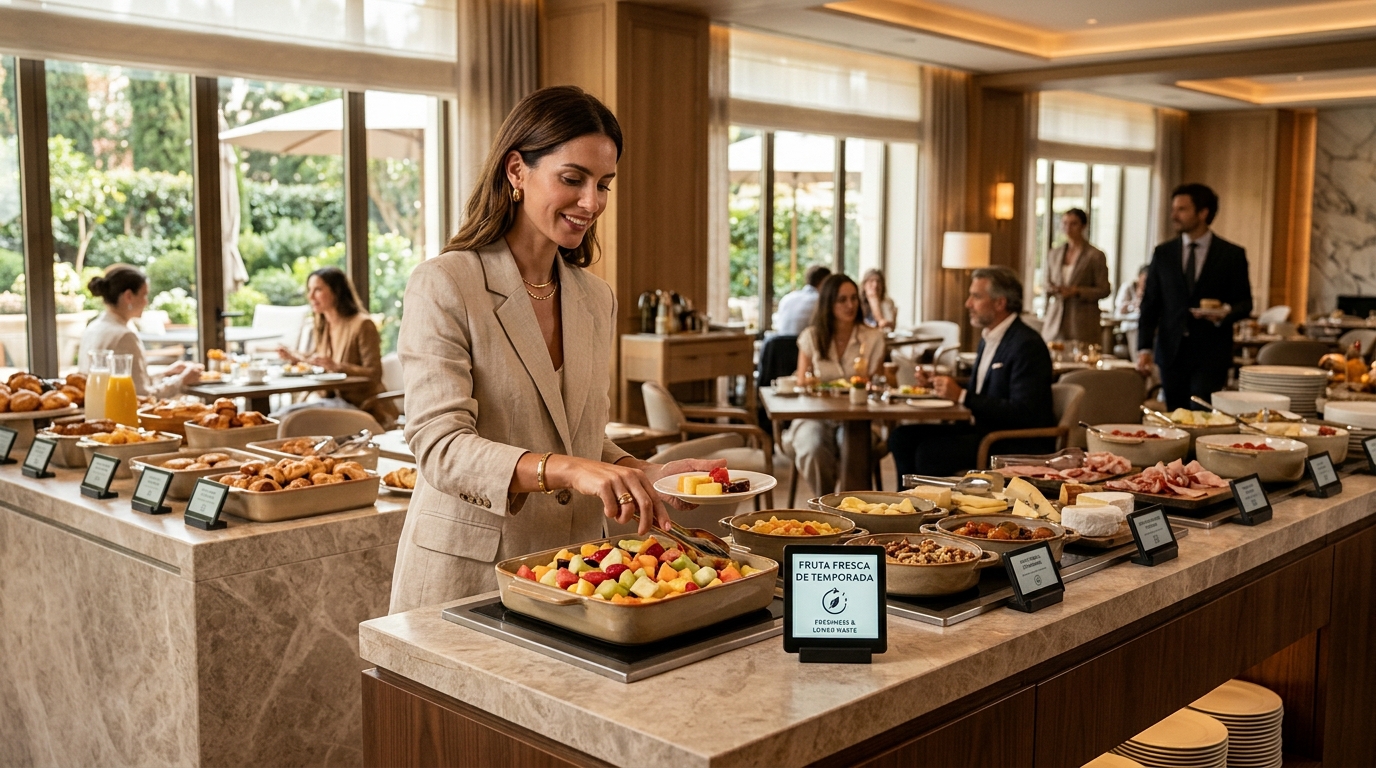
- Digital Buffet Labels with real-time updates (allergens, dish rotation).
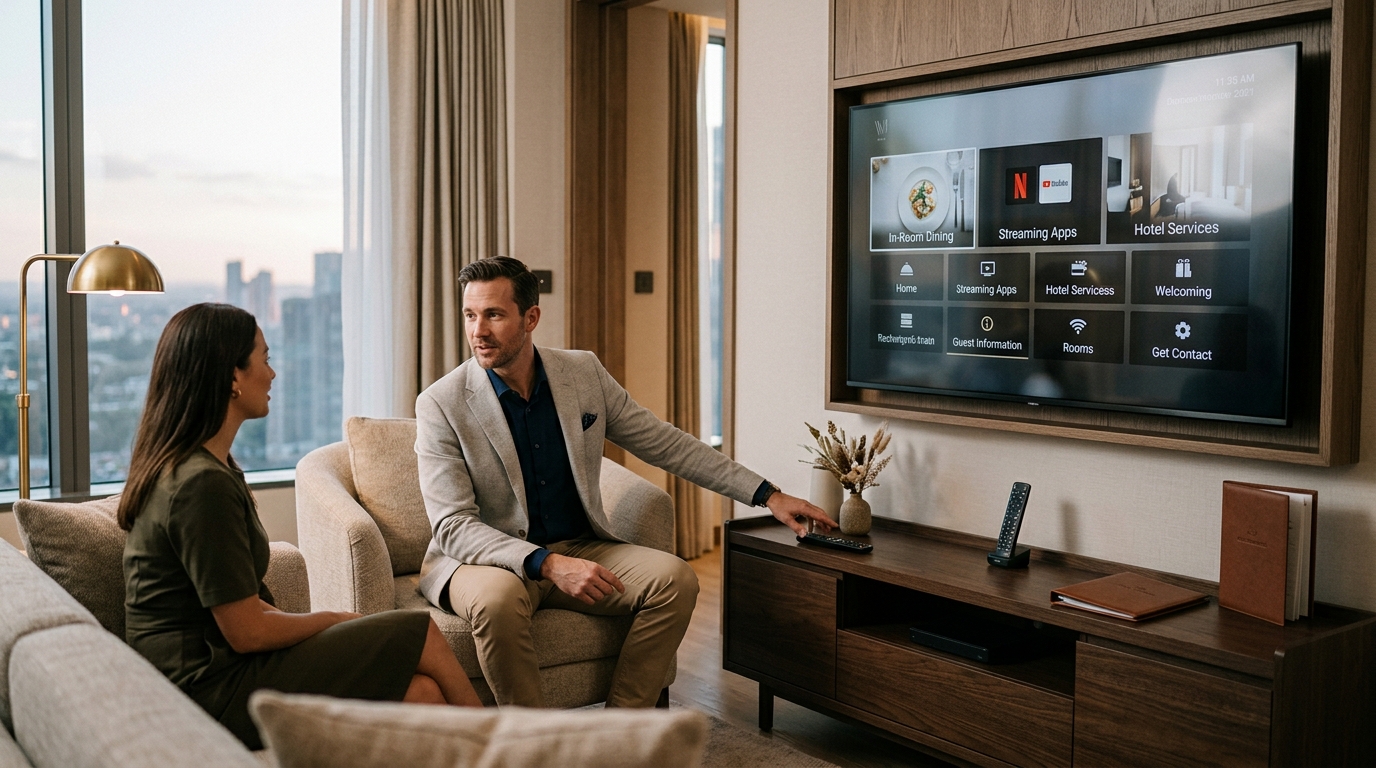
- TV Channel and Smart TV App in rooms.
- Corporate App for chains with their own identity.
- AiChat: AI-powered chatbot that reduces the volume of inquiries at reception.
Everything is managed from a unified CMS: a change in spa hours propagates simultaneously to the WebApp, TV, signage, and totems.
Modules Layer (Operational Functionality)
More than 15 modules that can be activated according to the hotel’s model: Restaurant Booking, Spa Booking, Sunbed Booking, Mini Club, Satisfaction Surveys, Capacity Control, Requests and Incidents, Room Service Digital, QR Ordering, Online Pre-Check-in, Item Lending, Digital Menu, Excursions and Activities, Vehicle Tracking, and Security Control.
The hotel pays only for the modules it activates and can scale progressively.
Use Cases: How Chains Apply It
Radisson — Multi-Property Consistency
Operating multiple hotels under the same brand requires homogeneity. The Hoteligy CMS allows corporate templates (typography, palette, tone) to be maintained while delegating only local content to each property: menus, schedules, events. The chain reduces the onboarding time for new properties from weeks to days.
H10 and Princess Hotels — Ancillary Revenue in Resorts
In resorts with multiple points of sale (a la carte restaurants, spa, excursions, premium sunbeds), the in-stay marketing module crosses WebApp and guest behavior data to display contextual offers: a romantic dinner for the guest on a honeymoon trip, a massage for the one who has consulted the spa twice without booking.
The typical result: increases in ancillary revenue per stay between 8% and 15% in all-inclusive properties, where the incremental margin on extra services is high.
Iberostar — Digitalized F&B Operations
Digital buffet labels and QR ordering at the pool free staff from repetitive tasks (rewriting small signs, taking orders on foot). The F&B team redirects hours toward direct guest service, which is reflected in the restaurant NPS.
Dunas Hotels and Spring Hotels — Reception Queue Reduction
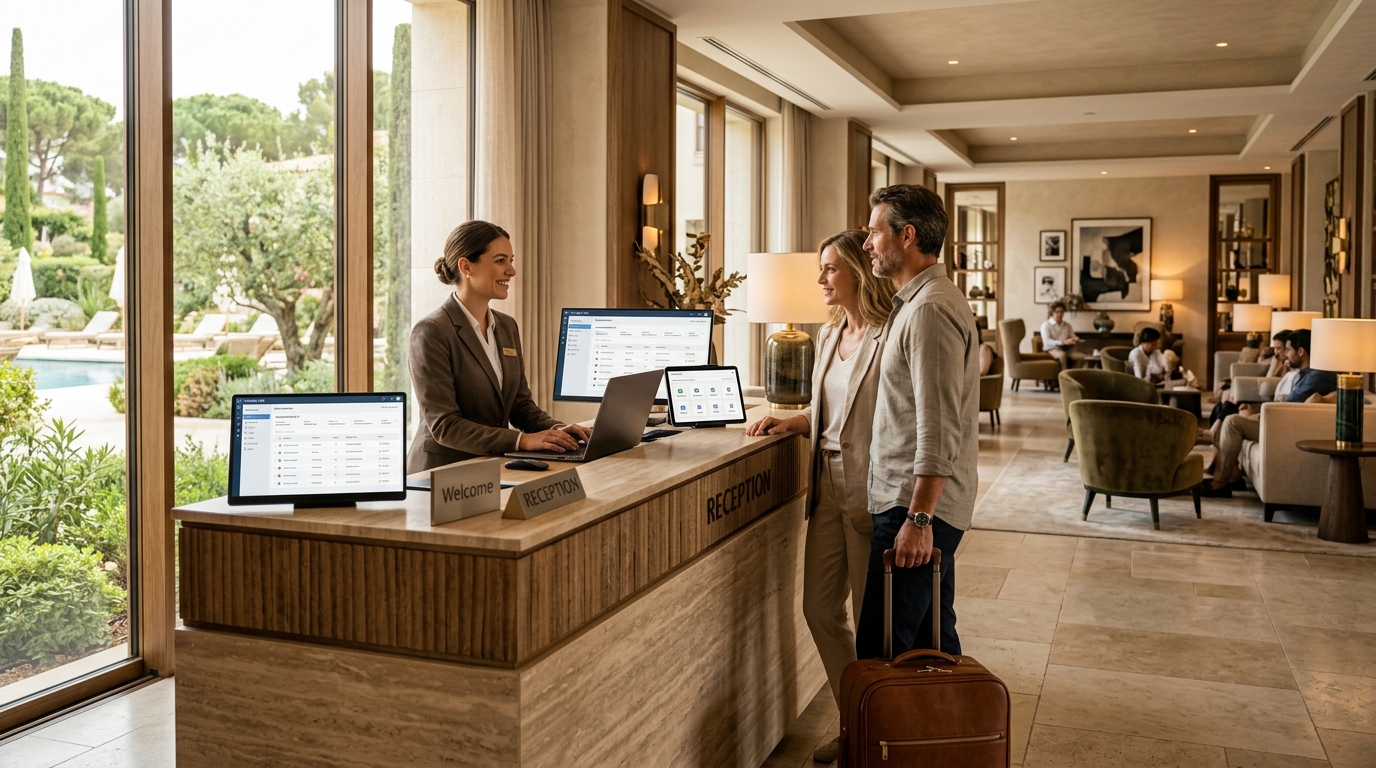
Online Pre-Check-in combined with interactive totems decongests the lobby during peak arrival times. The guest completes documentation, signature, and room selection before arrival; at reception, they only collect the key.
How to Plan the Deployment: A Phased Approach
Implementing a 360 CMS does not require a “big bang.” The recommended approach to minimize operational risk is:
Phase 1 — Quick Wins (Month 1-2)
- Guest WebApp + AiChat: covers 70% of operational guest inquiries and immediately reduces reception workload.
- Digital satisfaction surveys: start capturing NPS in real time.
Phase 2 — Monetization (Month 3-4)
- Activation of the In-Stay Marketing module with segmented campaigns.
- Restaurant, Spa, and Sunbed Booking: converts latent demand into revenue.
- Room Service Digital or QR Ordering depending on the model.
Phase 3 — Deep Operations (Month 5-6)
- Digital Signage and buffet labels.
- Unified TV Channel.
- Requests and Incidents to close the operational loop.
Each phase delivers measurable ROI before moving to the next, making internal justification to the financial department easier.
Integrations: The CMS Does Not Live Alone
A hotel CMS only provides real value if it connects with the rest of the stack. Hoteligy integrates natively with the main PMS (Opera, Protel, TesiPro, Sihot), payment gateways, reputation platforms, and POS systems. The integrations layer allows a spa booking made from the WebApp to automatically appear as a room charge, or the Pre-Check-in to update the status in the PMS without manual intervention.
Without this integration layer, any CMS becomes just another island. With it, it becomes the connector that brings coherence to the hotel’s digital ecosystem.
What Results to Expect
Based on aggregated data from the +200 properties operating with Hoteligy, the typical ranges after 6-12 months of operation with the full stack are:
- Ancillary revenue per stay: +8% to +15%.
- Reduction in reception inquiries: 30% to 50% (via AiChat and WebApp).
- NPS: +5 to +12 points due to reduced operational friction.
- Content update time: from weekly hours to minutes per change.
- Reduction of technology providers: consolidation of 6-10 contracts into 1.
Ranges vary depending on the model (urban vs. resort), size, and prior digital maturity. The best way to calculate a specific ROI is to review your current stack and map out which parts a platform like Hoteligy would consolidate.
Conclusion
A 360 CMS is not a technology project; it is an operational architecture decision. Consolidating WebApp, Signage, TV, AiChat, and booking modules into a single platform frees up time, aligns the brand, and unlocks data that was previously in silos.
Chains that have already made this transition do not compete on better technology, but on better execution capability: they take less time to launch campaigns, respond to feedback, and scale to new properties. If your hotel is still operating with 6 tools that do not talk to each other, the opportunity cost grows every month.
Want to see the Hoteligy CMS applied to your hotel? Request a personalized demo with our team at hoteligy.com/demo and let’s analyze together which modules would generate the greatest impact on your property.