Printed room directories are a thing of the past. With the rise of smartphones and changing guest behavior, these directories have become obsolete. We'll show you why and introduce you to a more sustainable alternative.
A hotel directory was born with a very practical goal – to provide guests with information about the hotel, its services, menus and information about the surroundings.
But in reality, are they really that useful?
High printing costs
Printing room directories is a considerable expense. Since the hotel is constantly updating its services and schedules, the directories quickly become outdated. Furthermore, after passing through many hands, the directories often have wrinkled, wet, or dirty pages, creating a poor impression and welcoming environment for our guests.
If we calculate that the average cost of a printed directory is €30, a 100-room hotel spends €3000 annually on replacement.
Outdated information
If the menu changes, or there's a change in service opening hours, hotel staff must reprint the additional materials and then go from room to room replacing the old information in the guest directory. This leads to outdated information in hotel rooms and dissatisfied guests.
Let's try an experiment. Go to your hotel room and check the directory. How many errors did you find?
Inappropriate format
“It’s listed in the directory, but nobody reads it,” many hoteliers say. And our question is – who wants to read a 30-page book on the first day of their vacation? Today’s guests need organized information, readily available, and that doesn’t require them to waste valuable vacation time searching for it.
Not only that, but guests are increasingly sensitive to sustainability policies, and seeing hotels waste paper, ink, and plastic on something that doesn’t add value for them seems like an unnecessary waste.
Why is it important for hotels to have a digital directory? To avoid all the problems mentioned above.
Costs
Investing in a digital tool, apart from other benefits it provides, is much more economical than a printed directory.
Update
We assure you that in case of changes, it will take you 2 minutes to update them and make them public.
Format
It's not the same to give the guest a book where they have to search for how to access the Spa, as it is to give them an App with an integrated search engine, where by simply typing the word "spa" they will have complete information, schedules, treatment menu, and even the option to book.
Here are three ideas to help you make the most of a digital directory and offer guests information quickly, specifically, and in an up-to-date manner.
1. Create a welcome letter
What if, instead of giving guests a stack of paperwork at check-in, we simply invited them to log into the app? This way, we increase engagement with the app and ensure that guests know it exists and that they can find all the information they need there. Once the guest logs into the app, we can provide them with a welcome letter containing the most important information they need to know.
2. Generate QR codes
One of the most sustainable options is to eliminate all printed information and replace it with a QR code, which has proven to be a simple and quick way to access the necessary information. We can generate a QR code for pool parameters, for example, and display it in the pool area, where guests can easily check the parameters. This also saves the Technical Service staff time that would otherwise be spent filling out the posted forms daily.
3. Personalize the content that the guest sees in the App
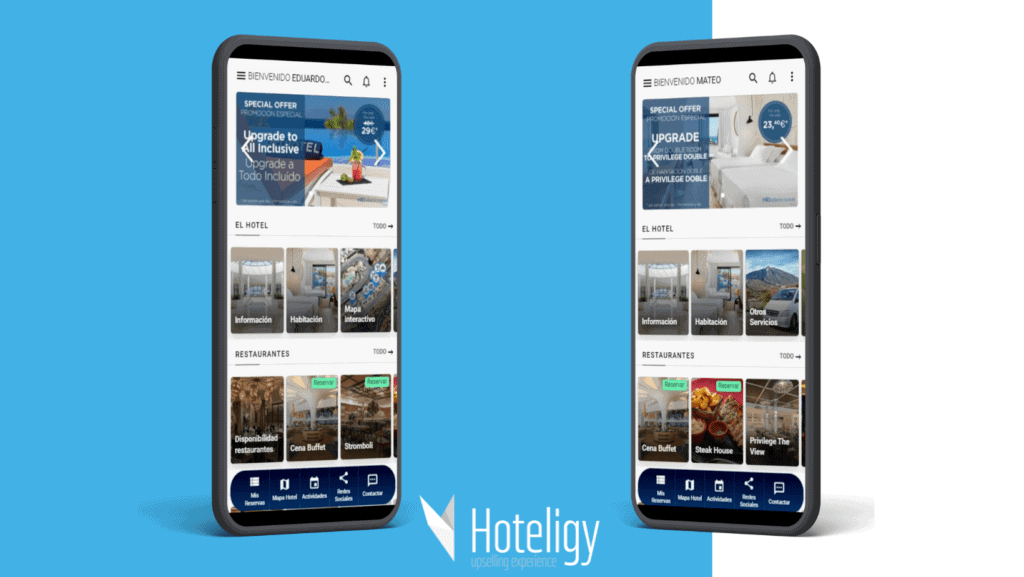
Thanks to Hoteligy's digital directory, it is possible to personalize the content that the guest sees, therefore, we can provide him only with the information that interests him.
There are several customization options – we can choose to have the page visible only to identified customers, or we can segment the pages by accommodation type or meal plan. What are the benefits? For example, we can ensure that jacuzzi instructions are only visible to guests staying in rooms with jacuzzis, or that children's events are only visible to those staying in family rooms. We can also launch upgrade offers that we don't want guests staying on that meal plan to see.
Correct information to the correct people.
Here's a statistic for you. During 2022, a total of 920,375 inquiries were made within the app at a 485-room hotel in Tenerife.
If only 10% of these inquiries were handled by phone or at reception, and if each inquiry took just 1 minute (which we know is the minimum) of your employees' time, we're talking about a savings of 1,534 hours per year . Multiplying that by the gross cost of an employee per hour, we arrive at an amount of €16,873 annually.
You may not own a 500-room hotel, but you will understand the impact of digitalization.
As we always remind you, a digital directory will not replace a receptionist, but it will reduce their workload.
If you think your target customer isn't ready for this step towards digitalization, consider how many people you know learned to use QR codes in record time during the pandemic. Even senior customers got used to scanning codes to view restaurant menus or to travel by train.
According to the results of the survey launched to the users of the App, they confirm that thanks to being able to search for information independently, they save time on their vacations, as they avoid queues and long waits at reception.
WebApp Standard: Remember that with our Hoteligy App Standard, you'll have access to a digital directory, interactive maps, digital menus from points of sale, and an entertainment schedule. It's a great foundation for digitizing your guest communication, and we can add many more functional modules. If you'd like more information, please fill out the form and we'll contact you shortly.